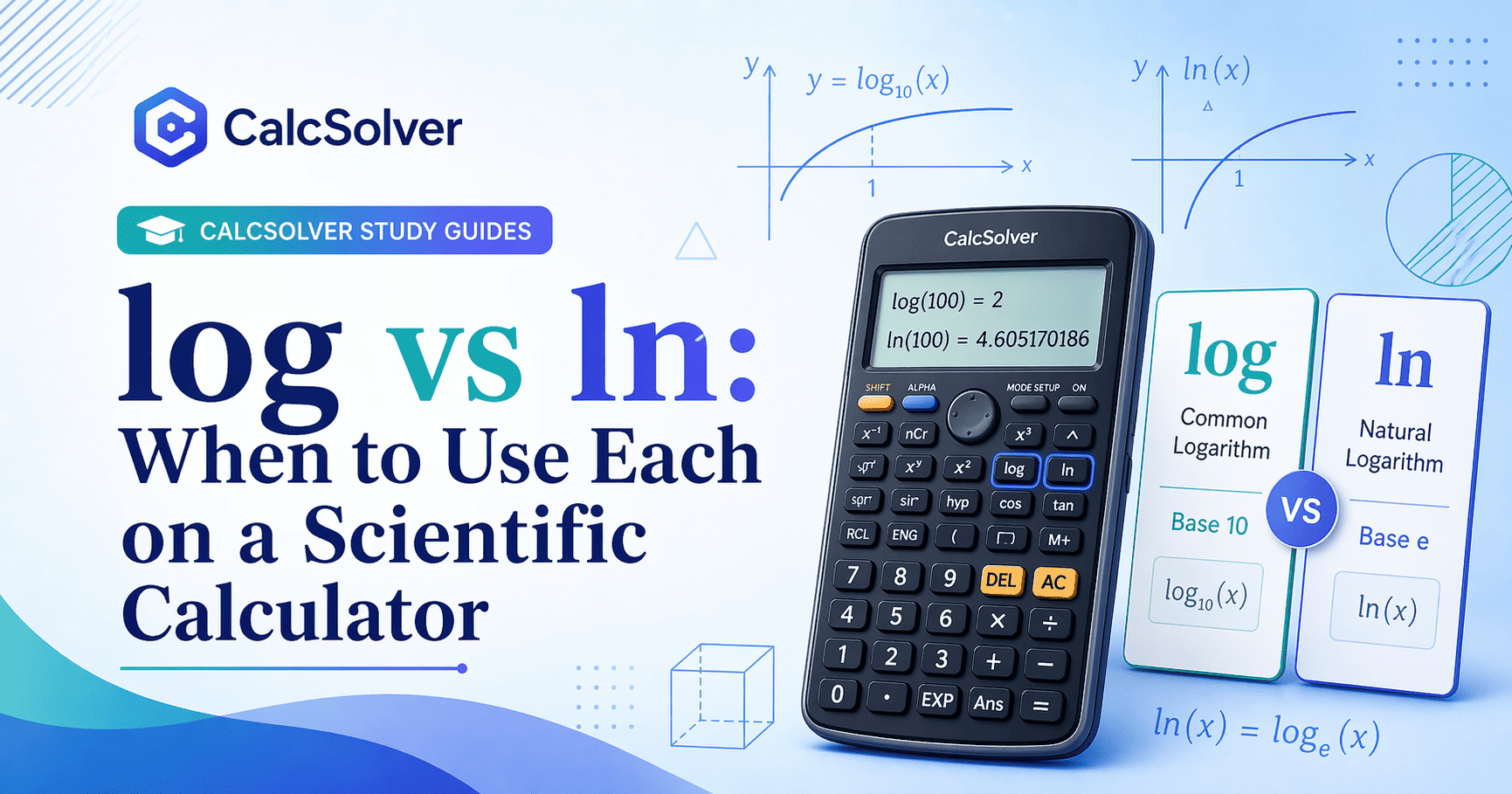
log vs ln: When to Use Each on a Scientific Calculator
Students often know that logarithms are related to exponents, but still press the wrong calculator key because the practical difference between log and ln is not fully clear. The issue is not that one is "advanced" and the other is "basic." The real issue is the base. Once the base is understood, the button choice becomes much easier.
This is one of those topics where a small conceptual gap produces a lot of calculator errors. The screen still gives a number, so the mistake is easy to miss. That is what makes log versus ln more important than it first appears. The wrong key does not usually produce an obvious crash. It produces a plausible but incorrect answer.
Applicable Use Cases
Use base-10 logs in topics such as pH, decibels, powers of ten, and order-of-magnitude reasoning. Use natural logs in growth and decay models, calculus, continuous compounding, and formulas built around the constant e. In many school problems, the surrounding formula tells you which one belongs.
This matters on a calculator because the wrong base can produce a perfectly valid number that is still the wrong answer for the question asked. Students often know how to press a key, but not why that key is correct for the model. This article is meant to close that gap.
Formula Principle
A logarithm asks: what exponent turns a chosen base into the target number? So log(100) = 2 means 10^2 = 100, while ln(e) = 1 means e^1 = e.
The key change-of-base rule connects them:
log_a(x) = ln(x) / ln(a)
This means even if a calculator only offered one log function, you could still compute other bases. Dedicated keys are mainly there to reduce steps and reduce input error.
The larger point is that base choice should come from the math context, not from habit. If the formula is built around powers of 10, base-10 log is usually natural. If the formula is built around e, continuous growth, or calculus, natural log is usually the cleaner choice. The calculator key follows the model.
Worked Examples
Example 1: log(1000). Ask what power of 10 gives 1000. The answer is 3, because 10^3 = 1000.
Example 2: ln(e). Ask what power of e gives e. The answer is 1.
Example 3: ln(1). Any base to the 0 power gives 1, so ln(1) = 0.
Example 4: Compute log base 2 of 8 without a base-2 key. Use change of base: log_2(8) = ln(8)/ln(2). That gives 3.
Example 5: Solve 10^x = 7. Take base-10 log of both sides. Then x = log(7). If you instead use natural log, it still works only because you apply it correctly to both sides and preserve the relationship. The key is consistency, not random key choice.
Example 6: Continuous growth model. If a formula involves e^{kt}, natural log is usually the most natural inverse operation because it matches the base already built into the model.
Common Mistakes
The most common mistake is using the wrong base because the problem statement was not read carefully. Another frequent error is forgetting that log and ln only accept positive real inputs in ordinary school math settings. Students also misuse log laws, especially by assuming log(a + b) = log(a) + log(b), which is false.
On calculators, parenthesis mistakes are common too. If a student tries a change-of-base expression like ln(8)/ln(2) but omits parentheses or mistypes only one side, the answer can drift without looking obviously broken.
Another subtle mistake is believing that the calculator choice is arbitrary because both logs are "kind of the same." They are related, but not interchangeable unless the algebra is handled correctly. Relationship is not the same as equivalence.
FAQ
Is log always base 10?
On most school calculators, yes. In some scientific writing, context may redefine the convention, so always read carefully.
Is ln harder than log?
No. It is simply a logarithm with base e instead of base 10.
Can I solve any log-base problem with change of base?
Yes, as long as the base is positive and not equal to 1, and the argument is positive in the real-number system.
Difference from Nearby Tools
Use the Scientific Calculator when you want to evaluate log or ln directly. Use the Scientific Calculator Guide for general key behavior and input habits. Use the Algebra page if the log question is part of a broader solve-for-x practice pattern.
Study Advice
Memorize a few anchors: log(10) = 1, log(100) = 2, ln(e) = 1, and ln(1) = 0. These values give you a quick mental check before trusting a calculator result.
When practicing, always say the base out loud: "base 10" or "base e." That verbal habit reduces random key-press mistakes and makes the logic of logarithms much more stable.
The larger study habit is to connect every logarithm to its inverse exponent meaning. If you keep asking "what power gives this result?" the buttons stop feeling like unrelated symbols and start feeling like natural operations.
Applied learning context
How this topic appears in real coursework
In real classes, this topic usually appears inside mixed assignments instead of in isolation. Students may need to combine definitions, formulas, and interpretation in a single response, which is why practicing only one template answer is often not enough. A stronger routine is to check what the question is really asking, identify the required variables, then map the setup to the correct method before calculating.
Common reasoning traps and how to prevent them
The most frequent mistakes happen before arithmetic starts: reading symbols too quickly, mixing units, applying the wrong formula, or skipping assumptions. To avoid this, write a short pre-check line for each problem: identify known values, unknown values, constraints, and expected answer size. This one-minute habit prevents many avoidable errors and improves final answer quality more than repeated button pressing.
How to self-verify before submitting answers
After solving, verify by estimation and by method. Estimation checks whether the result is in a plausible range. Method checks whether each step still matches the original question intent. If either check fails, revise the setup first instead of retyping numbers. This approach builds transferable problem-solving skill, not just short-term answer accuracy.