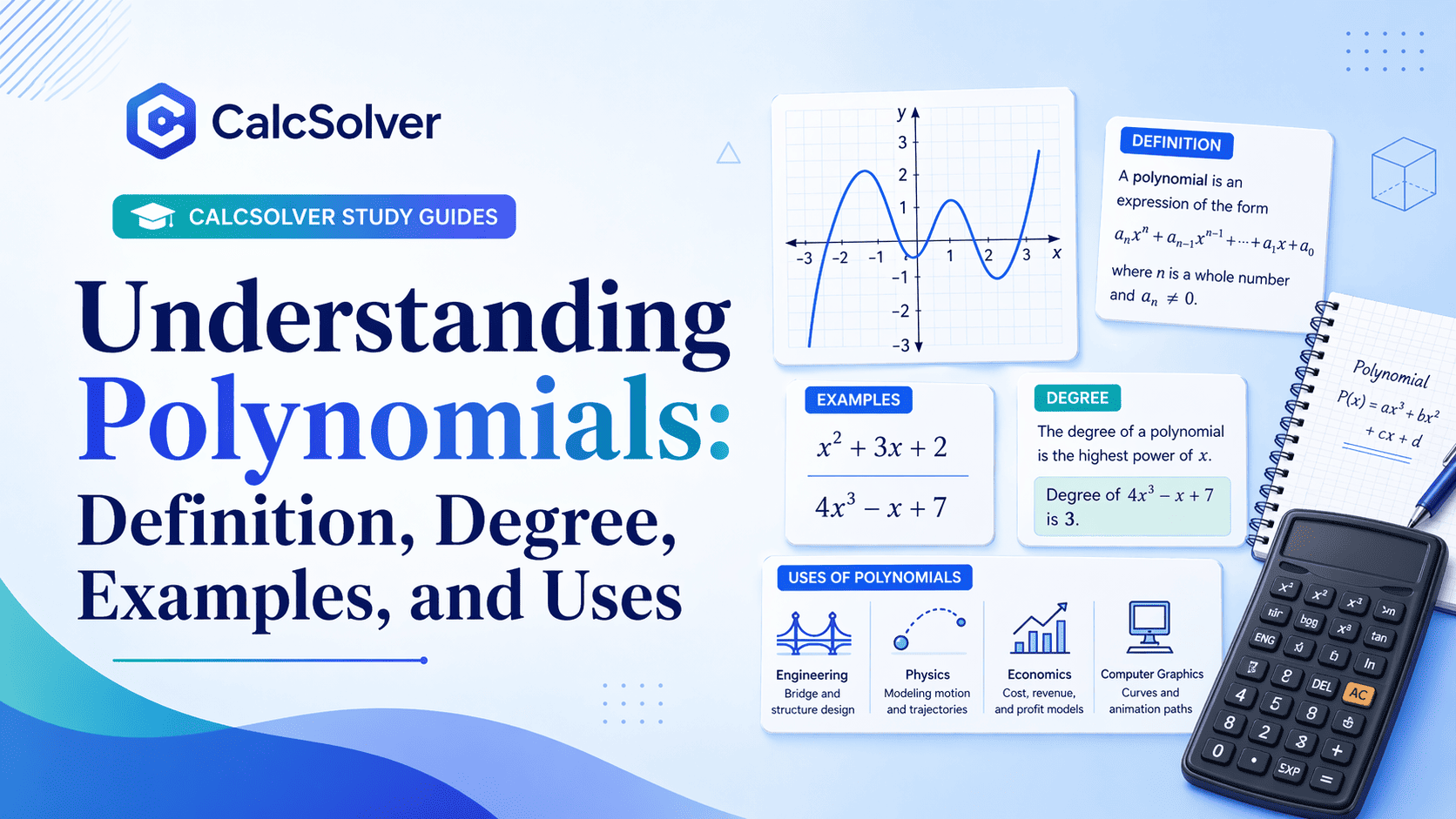
Understanding Polynomials: Definition, Degree, Examples, and Uses
Polynomials are one of the central objects in algebra because they are simple enough to manipulate by hand but rich enough to model many real mathematical situations. Students meet them early, but the topic keeps returning in graphing, factoring, division, and calculus. A good understanding of polynomials makes many later topics feel less fragmented.
The main reason polynomials matter so much is stability. When you add, subtract, or multiply them, you stay inside the same family of expressions. That makes them unusually convenient for algebraic work and one reason they appear everywhere in textbooks.
Applicable Use Cases
You use polynomials when simplifying algebraic expressions, solving equations, studying graphs, approximating curves, or building models for area, motion, and profit. They also appear constantly in textbook exercises because they are stable under addition, subtraction, and multiplication.
They are also the foundation for several later techniques students often meet as separate chapters. Once you start factoring polynomials, dividing them, or using the Remainder Theorem, you are still working inside the same family. That continuity is part of why the definition matters.
Core Ideas
A polynomial in x is a sum of terms of the form a*x^n where the exponent n is a non-negative integer. That means no negative powers, no variable in the denominator, and no fractional exponents if the expression is to remain a polynomial in the ordinary school sense.
The degree of a polynomial is the highest exponent present with a nonzero coefficient. The leading term is the term with that highest exponent, and the leading coefficient is the coefficient attached to that term. These help determine the overall behavior of the graph for large values of x.
That is why degree matters so much. It is not just a label. It helps predict how a polynomial behaves, how many turning points it might have, and which algebraic tools are likely to be useful next.
Another useful classification is by number of terms: monomial, binomial, and trinomial. While this naming system is simpler than degree, it still helps students describe expressions accurately and talk about likely methods. A binomial might invite difference-of-squares thinking, while a trinomial might invite factoring or quadratic analysis.
Worked Examples
Example 1: 3x^2 - 5x + 2 is a polynomial of degree 2.
Example 2: 7 is a constant polynomial of degree 0.
Example 3: x^4 is a monomial polynomial of degree 4.
Example 4: 1/x + 3 is not a polynomial because x appears in the denominator, which means a negative exponent is involved.
Example 5: To evaluate 2x^2 - x + 3 at x = 4, compute 2(16) - 4 + 3 = 31.
Example 6: sqrt(x) + 1 is not a polynomial in the standard school sense because the variable is raised to a fractional exponent.
Example 7: 2x^3y + 5xy^2 - 7 is a multivariable polynomial. This is a helpful example because it shows that "polynomial" does not mean "one variable only."
Common Mistakes
The most common mistake is calling any algebraic expression a polynomial. Expressions with roots of variables, variable denominators, or fractional exponents do not qualify in the standard definition. Another mistake is confusing term count with degree. A two-term expression can still have a high degree.
Students also forget that the zero polynomial is a special case and that leading coefficients can be negative. These details matter when describing graph behavior and comparing forms.
Another common confusion is mixing up the number of terms with the degree. A polynomial can have very few terms and still have a high degree.
FAQ
Is every monomial a polynomial?
Yes, if its exponent rules fit the definition.
Why does degree matter?
Degree helps predict graph shape, end behavior, and which factoring or division tools may apply.
Can a polynomial have more than one variable?
Yes. Multivariable polynomials exist, though many school examples begin with one variable.
Difference from Nearby Tools
Use the Algebra page for direct evaluation and basic solving. Use Factoring Polynomials and Polynomial Division when the topic moves from definition into technique. Use the Scientific Calculator to test polynomial values quickly.
Study Advice
When classifying expressions, check exponents first. That single test removes a lot of confusion. It also helps to separate three questions in your mind: Is it a polynomial? What is its degree? How many terms does it have? Students who keep those questions distinct usually make fewer description errors.
The larger point is that polynomials are not just a vocabulary chapter. They are the base language for many later techniques. Learning to classify them clearly pays off across multiple units.
A strong practice routine is to take mixed lists of expressions and label each one by type, degree, and whether it qualifies as a polynomial at all. That kind of classification work builds faster judgment than only solving one style of problem repeatedly.
Applied learning context
How this topic appears in real coursework
In real classes, this topic usually appears inside mixed assignments instead of in isolation. Students may need to combine definitions, formulas, and interpretation in a single response, which is why practicing only one template answer is often not enough. A stronger routine is to check what the question is really asking, identify the required variables, then map the setup to the correct method before calculating.
Common reasoning traps and how to prevent them
The most frequent mistakes happen before arithmetic starts: reading symbols too quickly, mixing units, applying the wrong formula, or skipping assumptions. To avoid this, write a short pre-check line for each problem: identify known values, unknown values, constraints, and expected answer size. This one-minute habit prevents many avoidable errors and improves final answer quality more than repeated button pressing.
How to self-verify before submitting answers
After solving, verify by estimation and by method. Estimation checks whether the result is in a plausible range. Method checks whether each step still matches the original question intent. If either check fails, revise the setup first instead of retyping numbers. This approach builds transferable problem-solving skill, not just short-term answer accuracy.