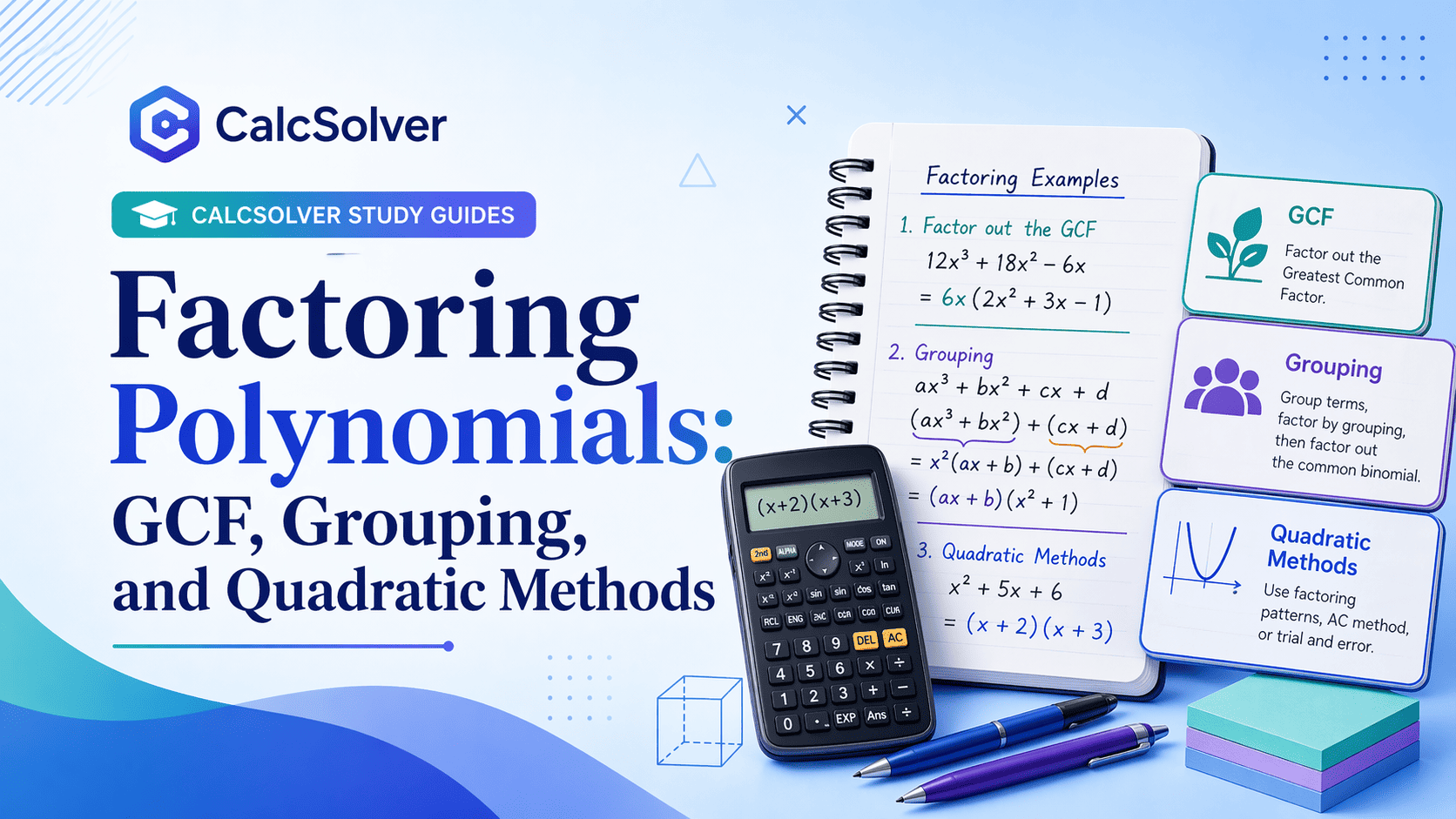
Factoring Polynomials: GCF, Grouping, and Quadratic Methods
Factoring is the process of rewriting a polynomial as a product of simpler expressions. It matters because products are often easier to solve, simplify, and interpret than expanded forms. Students often think factoring is a random guessing game, but it becomes much more systematic once you learn a stable order of attack.
The big shift is to stop asking "what should I try first?" in a random way and start using a consistent checklist. Once factoring has an order, it stops feeling like trial-and-error and starts feeling like pattern recognition with verification.
Applicable Use Cases
Factoring is used when solving polynomial equations, simplifying rational expressions, finding intercepts, and preparing expressions for division or graph analysis. It is also one of the main bridges between algebraic structure and equation solving.
It also matters because many algebra topics become easier after factoring changes the form. A dense expression can become a clean product, and that product often reveals roots, repeated factors, or symmetry that the expanded form was hiding.
Method Ideas
A reliable factoring checklist is: first look for a greatest common factor, then look for special patterns, then try trinomial methods, and finally grouping if the expression has four terms or an awkward middle structure. This order prevents wasted effort.
The reason factoring works is that multiplication distributes. If you can recognize how a polynomial may have been built by multiplication, you can reverse the process.
This is also why verification matters. A factorization is not finished until you can justify it by multiplying back out or testing the structure another way.
A useful judgment rule is to match the method to the visible pattern. Two terms may suggest a common factor or difference of squares. Three terms may suggest a trinomial method. Four terms may invite grouping. That pattern-to-method link is what makes factoring feel organized rather than random.
Worked Examples
Example 1: Factor 6x^2 + 12x. First pull out the GCF 6x. Result: 6x(x + 2).
Example 2: Factor x^2 - 9. This is a difference of squares, so it becomes (x + 3)(x - 3).
Example 3: Factor x^2 + 5x + 6. Look for two numbers that multiply to 6 and add to 5. They are 2 and 3, so the factorization is (x + 2)(x + 3).
Example 4: Factor 2x^2 + 7x + 3. Use the ac method. Since a*c = 6, split the middle term: 2x^2 + 6x + x + 3. Group to get (2x + 1)(x + 3).
Example 5: Factor x^3 + 2x^2 + 3x + 6. Group: x^2(x + 2) + 3(x + 2). Result: (x + 2)(x^2 + 3).
Example 6: Why GCF comes first. If you skip the greatest common factor at the start, later factoring steps often look more complicated than they really are. Pulling out the shared factor first usually reveals the true structure.
Example 7: Check by expansion. After factoring (x + 2)(x + 3), multiplying back gives x^2 + 5x + 6. That reverse check is one of the best ways to catch sign mistakes.
Common Mistakes
The most common factoring mistake is skipping the GCF. Another is using the wrong pair of numbers in a trinomial because the student checked the product but not the sum, or vice versa. Sign errors in grouping are also common, especially when one group should factor out a negative.
Students also sometimes force a factorization where none exists over the integers. Not every polynomial factors nicely in a basic classroom setting, and recognizing that is part of the skill.
Another subtle mistake is stopping after one factoring step and not checking whether the resulting factors can themselves be factored further.
FAQ
Should I always factor completely?
Yes, unless the problem says otherwise. That usually means checking whether any factor can itself be factored further.
Is factoring the same as solving?
No. Factoring rewrites the expression. Solving uses the factorization to find values that make the expression zero.
Why does grouping sometimes fail?
Because not every four-term polynomial shares a useful grouping structure, or the grouping may need to be arranged differently.
Difference from Nearby Tools
Use Algebra Formulas when you need pattern identities such as difference of squares. Use Polynomial Division when factoring depends on quotient and remainder ideas. Use the Scientific Calculator to test whether two forms match at sample values.
Study Advice
Build a fixed routine. Ask: GCF first? special pattern? trinomial? grouping? That habit removes guesswork. It also helps to verify a factorization by multiplying it back out or testing one or two values numerically. Verification is not extra work. It is part of correct algebra.
The larger lesson is that factoring is really about seeing multiplication backwards. Once students internalize that idea, the chapter becomes far less mechanical and much more coherent.
If you want faster improvement, keep a short log of mistakes by category: skipped GCF, wrong sign pair, incomplete factoring, or failed grouping. Error patterns in factoring are usually repetitive, which means they are very fixable once identified.
Applied learning context
How this topic appears in real coursework
In real classes, this topic usually appears inside mixed assignments instead of in isolation. Students may need to combine definitions, formulas, and interpretation in a single response, which is why practicing only one template answer is often not enough. A stronger routine is to check what the question is really asking, identify the required variables, then map the setup to the correct method before calculating.
Common reasoning traps and how to prevent them
The most frequent mistakes happen before arithmetic starts: reading symbols too quickly, mixing units, applying the wrong formula, or skipping assumptions. To avoid this, write a short pre-check line for each problem: identify known values, unknown values, constraints, and expected answer size. This one-minute habit prevents many avoidable errors and improves final answer quality more than repeated button pressing.
How to self-verify before submitting answers
After solving, verify by estimation and by method. Estimation checks whether the result is in a plausible range. Method checks whether each step still matches the original question intent. If either check fails, revise the setup first instead of retyping numbers. This approach builds transferable problem-solving skill, not just short-term answer accuracy.