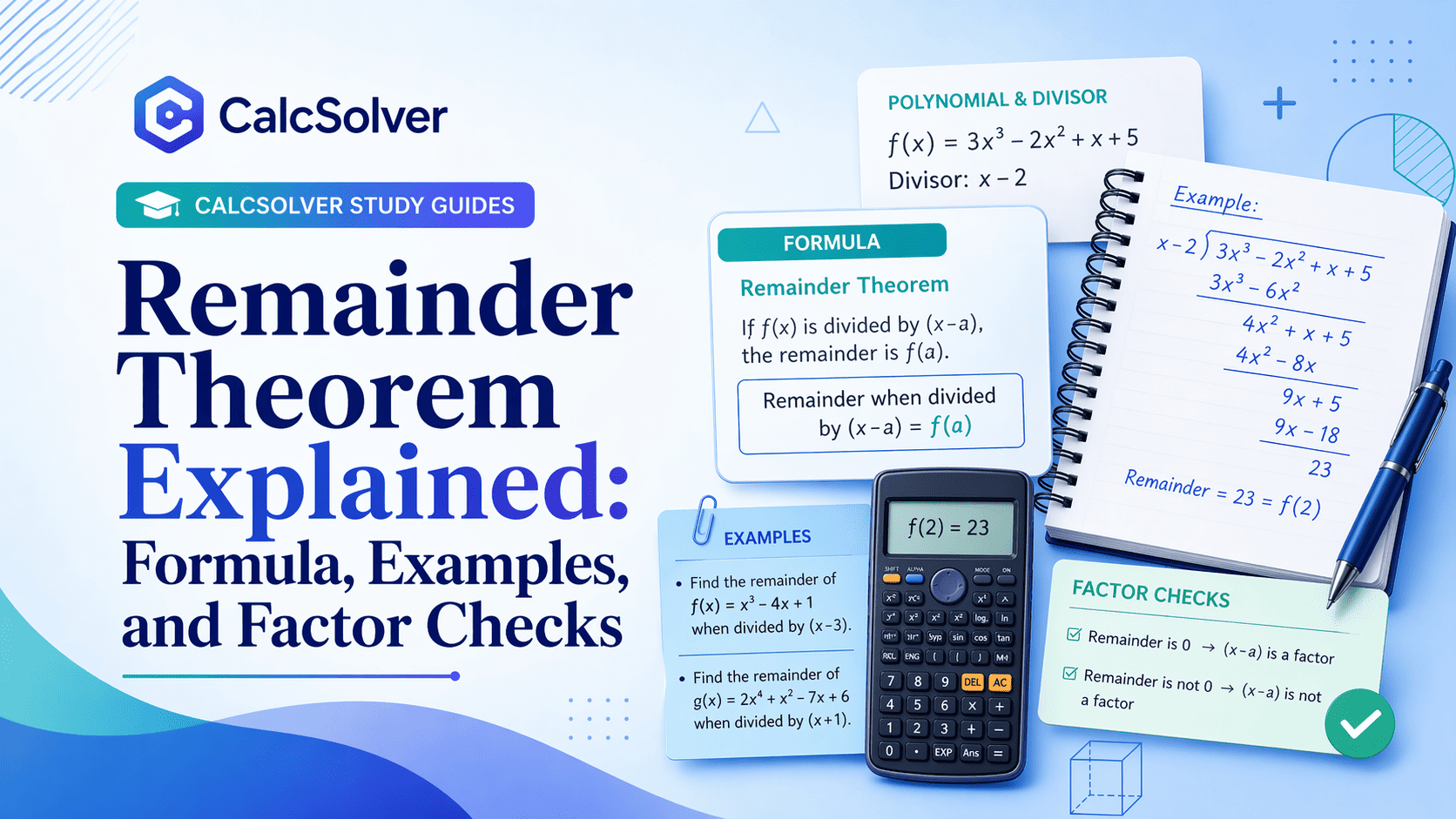
Remainder Theorem Explained: Formula, Examples, and Factor Checks
The Remainder Theorem is powerful because it turns a division question into an evaluation question. Instead of carrying out full polynomial long division every time, you can often find the remainder by substituting one value into the polynomial. That makes the theorem one of the fastest shortcuts in algebra once you understand the sign conventions.
What makes this theorem valuable is not only speed. It also connects several topics that students often learn separately: division, factor testing, roots, and synthetic division. Once those topics are seen as one system, the theorem feels much less like a trick and much more like a natural consequence of structure.
Applicable Use Cases
You use the Remainder Theorem when a problem asks for the remainder after dividing by a linear factor, or when you want to test whether a linear expression is a factor. It also helps connect synthetic division, factoring, and root-finding into one consistent idea.
It is especially useful when you do not need the full quotient. If the question only cares about the remainder or whether a factor works, the theorem often saves a large amount of writing.
That makes it especially valuable on timed work. Instead of writing a full long-division setup for every possible test factor, you can evaluate strategically and narrow the problem much faster.
Core Idea
If a polynomial P(x) is divided by (x - a), then the remainder is P(a). This follows from the division identity P(x) = (x - a)Q(x) + R. Setting x = a makes the first term vanish, leaving only the remainder.
This also explains the Factor Theorem. If P(a) = 0, then the remainder is zero, which means (x - a) divides the polynomial exactly.
The sign convention is the part that needs the most discipline. The divisor must be read in the form x - a. That means a divisor like x + 4 must be interpreted as x - (-4).
The theorem is also a good example of why algebra values structure. A full division process and a quick substitution can produce the same remainder because they are expressing the same relationship in different forms.
Worked Examples
Example 1: Find the remainder when P(x) = x^3 - 2x^2 + 3x - 1 is divided by x - 2. Compute P(2) = 8 - 8 + 6 - 1 = 5. The remainder is 5.
Example 2: Find the remainder when 2x^3 + x^2 - 5x + 3 is divided by x + 1. Use a = -1. Then P(-1) = -2 + 1 + 5 + 3 = 7.
Example 3: Test whether x - 3 is a factor of x^3 - 6x^2 + 11x - 6. Compute P(3) = 27 - 54 + 33 - 6 = 0. So it is a factor.
Example 4: For divisor x + 4, remember to use a = -4, not +4.
Example 5: If a problem needs the full quotient as well as the remainder, then the theorem gives only the remainder. Division or synthetic division may still be required.
Example 6: The theorem is fastest when the divisor is linear. If the divisor is quadratic or more complicated, the direct substitution shortcut does not apply in the same way.
Example 7: If several candidate factors are being tested, the theorem lets you compare them quickly by evaluating several values of P(a) rather than running full division each time.
Common Mistakes
The most common mistake is sign confusion. For x + 1, the correct value is a = -1. Another mistake is assuming the theorem works unchanged for nonlinear divisors. The direct shortcut P(a) applies to linear divisors of the form x - a.
Students also confuse remainder with quotient or forget that a zero remainder means "factor," not merely "nice number."
Another mistake is evaluating carelessly when the polynomial includes missing powers or several sign changes. The theorem is short, but sloppy arithmetic can still break it.
FAQ
Is the Remainder Theorem the same as synthetic division?
No, but they are closely related. Synthetic division can produce both quotient and remainder, while the theorem gives the remainder directly.
How do I test x + 5?
Rewrite it mentally as x - (-5), so a = -5.
What if the remainder is zero?
Then the divisor is a factor of the polynomial.
Difference from Nearby Tools
Use Polynomial Division when you need the quotient steps. Use Factoring Polynomials when the remainder test is part of a larger factoring strategy. Use the Scientific Calculator to evaluate P(a) quickly and check arithmetic.
Study Advice
Whenever you see a divisor of the form x - a, pause and ask whether the theorem can save time. Also make it a habit to state the value of a explicitly before calculating. That one step prevents many sign mistakes and keeps the shortcut reliable.
The bigger study lesson is that many algebra shortcuts are really structure shortcuts. The more clearly you can see the structure, the less work you need to do mechanically.
A strong practice habit is to pair the theorem with one verification round of synthetic division on the same example. Seeing both methods agree builds confidence and helps the shortcut feel justified rather than magical.
Applied learning context
How this topic appears in real coursework
In real classes, this topic usually appears inside mixed assignments instead of in isolation. Students may need to combine definitions, formulas, and interpretation in a single response, which is why practicing only one template answer is often not enough. A stronger routine is to check what the question is really asking, identify the required variables, then map the setup to the correct method before calculating.
Common reasoning traps and how to prevent them
The most frequent mistakes happen before arithmetic starts: reading symbols too quickly, mixing units, applying the wrong formula, or skipping assumptions. To avoid this, write a short pre-check line for each problem: identify known values, unknown values, constraints, and expected answer size. This one-minute habit prevents many avoidable errors and improves final answer quality more than repeated button pressing.
How to self-verify before submitting answers
After solving, verify by estimation and by method. Estimation checks whether the result is in a plausible range. Method checks whether each step still matches the original question intent. If either check fails, revise the setup first instead of retyping numbers. This approach builds transferable problem-solving skill, not just short-term answer accuracy.