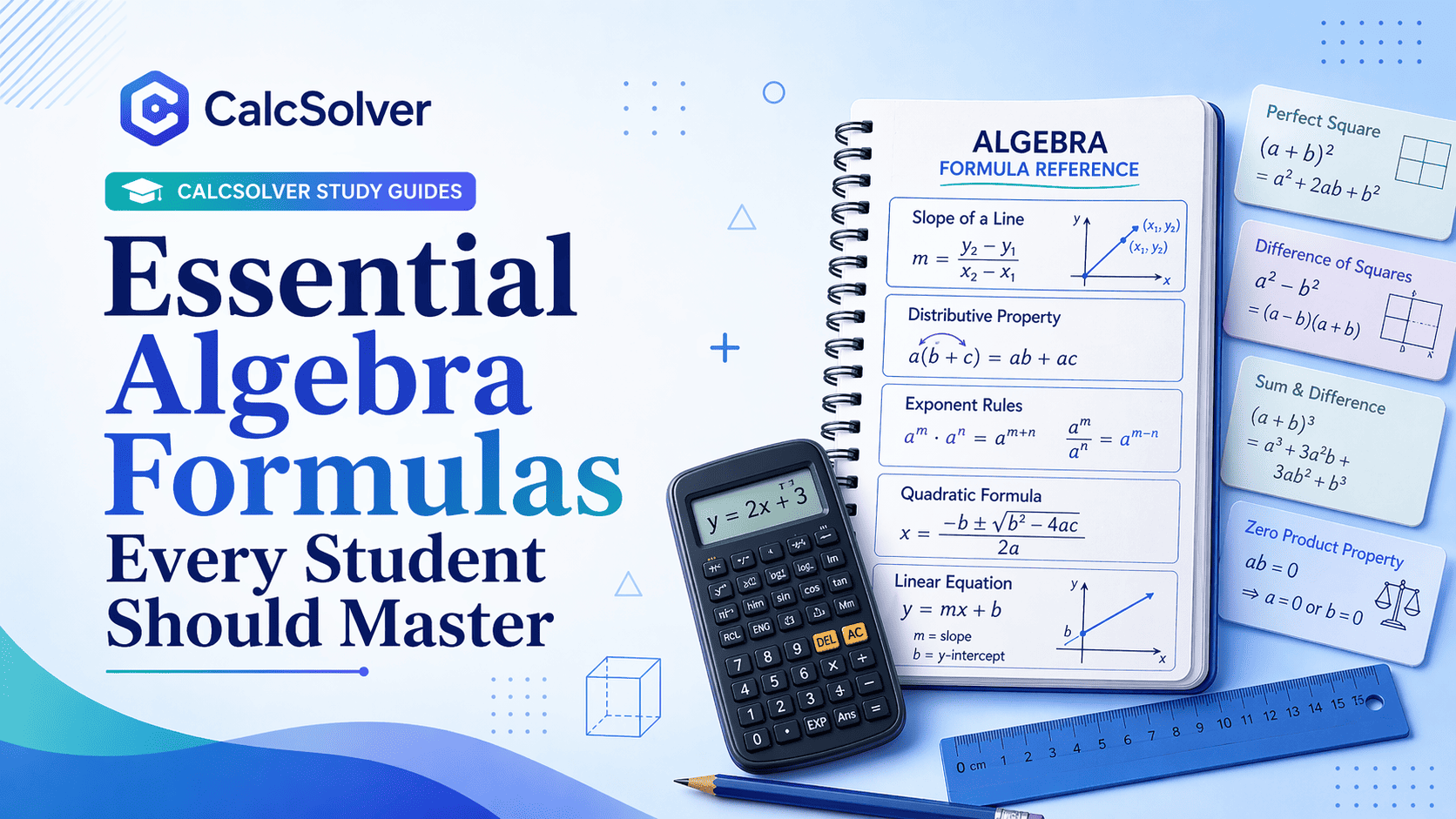
Essential Algebra Formulas Every Student Should Master
Algebra becomes much easier once a few formulas stop feeling like isolated facts and start feeling like reusable tools. Students often struggle not because the formulas are too hard, but because they do not know when a formula applies, what each symbol means, or how to verify the result. This guide focuses on the formulas that appear repeatedly in school algebra: the quadratic formula, difference of squares, and binomial square identities.
The practical value of memorizing formulas is not speed alone. A good formula shortens the distance between pattern recognition and action. The real skill is not reciting the formula perfectly. It is knowing which structure in front of you should trigger which formula.
Applicable Use Cases
These formulas appear in solving equations, factoring, simplifying expressions, checking graph intercepts, and preparing for higher-level topics such as calculus and physics. If a trinomial will not factor cleanly, the quadratic formula often saves the problem. If an expression looks like one square minus another, difference of squares may unlock it instantly.
Students also use these formulas when reversing work. For example, after factoring a polynomial, you may expand it again using binomial identities to confirm the structure. That back-and-forth is how formula knowledge becomes reliable rather than memorized.
Formula Principles
The quadratic formula solves ax^2 + bx + c = 0:
x = (-b ¡À sqrt(b^2 - 4ac)) / (2a)
The quantity b^2 - 4ac is the discriminant. It tells you how many real roots the quadratic has.
Difference of squares follows this identity:
a^2 - b^2 = (a + b)(a - b)
Binomial square identities are:
(a + b)^2 = a^2 + 2ab + b^2
(a - b)^2 = a^2 - 2ab + b^2
These formulas are related because they all organize repeated multiplication in predictable ways. The more you notice that connection, the less random algebra starts to feel.
Worked Examples
Example 1: Solve x^2 - 5x + 6 = 0. Here a = 1, b = -5, c = 6. The discriminant is 25 - 24 = 1. So x = (5 ¡À 1)/2, which gives x = 3 or x = 2.
Example 2: Factor 4x^2 - 25. This is a difference of squares: (2x)^2 - 5^2. So the factorization is (2x + 5)(2x - 5).
Example 3: Expand (x + 4)^2. Use the binomial square formula: x^2 + 8x + 16.
Example 4: Expand (3a - 2)^2. This becomes 9a^2 - 12a + 4. The middle term is where many errors happen.
Example 5: Solve 2x^2 + 7x + 3 = 0. The discriminant is 49 - 24 = 25. Then x = (-7 ¡À 5)/4, so the roots are -1/2 and -3.
Example 6: Spot a pattern before expanding. If you see a^2 - b^2, do not expand random terms. Check for difference of squares first. Pattern recognition is often faster than brute force.
Common Mistakes
The biggest quadratic-formula error is dropping the plus-or-minus symbol and reporting only one root. Another is misreading -b and forgetting that if b is already negative, then -b becomes positive. For binomial squares, students often forget the middle term 2ab. For difference of squares, many confuse (a - b)^2 with a^2 - b^2, but they are not the same.
A broader mistake is applying a formula because it looks familiar rather than because the structure truly matches. Formula use should be driven by pattern fit, not by hope.
FAQ
Should I factor or use the quadratic formula?
If the quadratic factors quickly, factoring is often faster. If not, the quadratic formula is the reliable fallback.
What does a negative discriminant mean?
It means the quadratic has no real roots, though complex roots still exist.
Why memorize these if I have a calculator?
Because the calculator does not decide which structure applies. Formula recognition is still your job.
What is the best way to remember formulas long-term?
Connect each formula to a pattern and a worked example, not just to a line of symbols.
Difference from Nearby Tools
Use the Algebra page for simple equation-solving and substitution. Use Factoring Polynomials when the task is primarily about decomposing expressions. Use the Scientific Calculator to verify roots, discriminants, and expansions numerically.
Study Advice
Do not memorize formulas as disconnected lines. Pair each one with a visual pattern and a test example. For instance, every time you see a subtraction of two perfect squares, say "difference of squares" out loud. Every time you square a binomial, force yourself to check whether the middle term is present. That habit matters more than memorization alone.
It also helps to verify one example of each formula on the calculator after doing it by hand. That confirmation loop builds confidence and catches sign mistakes quickly.
The larger goal is not to become a formula collector. It is to build enough pattern fluency that algebra starts to feel organized. Once the patterns are familiar, many problems become decision problems rather than memory problems.
Applied learning context
How this topic appears in real coursework
In real classes, this topic usually appears inside mixed assignments instead of in isolation. Students may need to combine definitions, formulas, and interpretation in a single response, which is why practicing only one template answer is often not enough. A stronger routine is to check what the question is really asking, identify the required variables, then map the setup to the correct method before calculating.
Common reasoning traps and how to prevent them
The most frequent mistakes happen before arithmetic starts: reading symbols too quickly, mixing units, applying the wrong formula, or skipping assumptions. To avoid this, write a short pre-check line for each problem: identify known values, unknown values, constraints, and expected answer size. This one-minute habit prevents many avoidable errors and improves final answer quality more than repeated button pressing.
How to self-verify before submitting answers
After solving, verify by estimation and by method. Estimation checks whether the result is in a plausible range. Method checks whether each step still matches the original question intent. If either check fails, revise the setup first instead of retyping numbers. This approach builds transferable problem-solving skill, not just short-term answer accuracy.