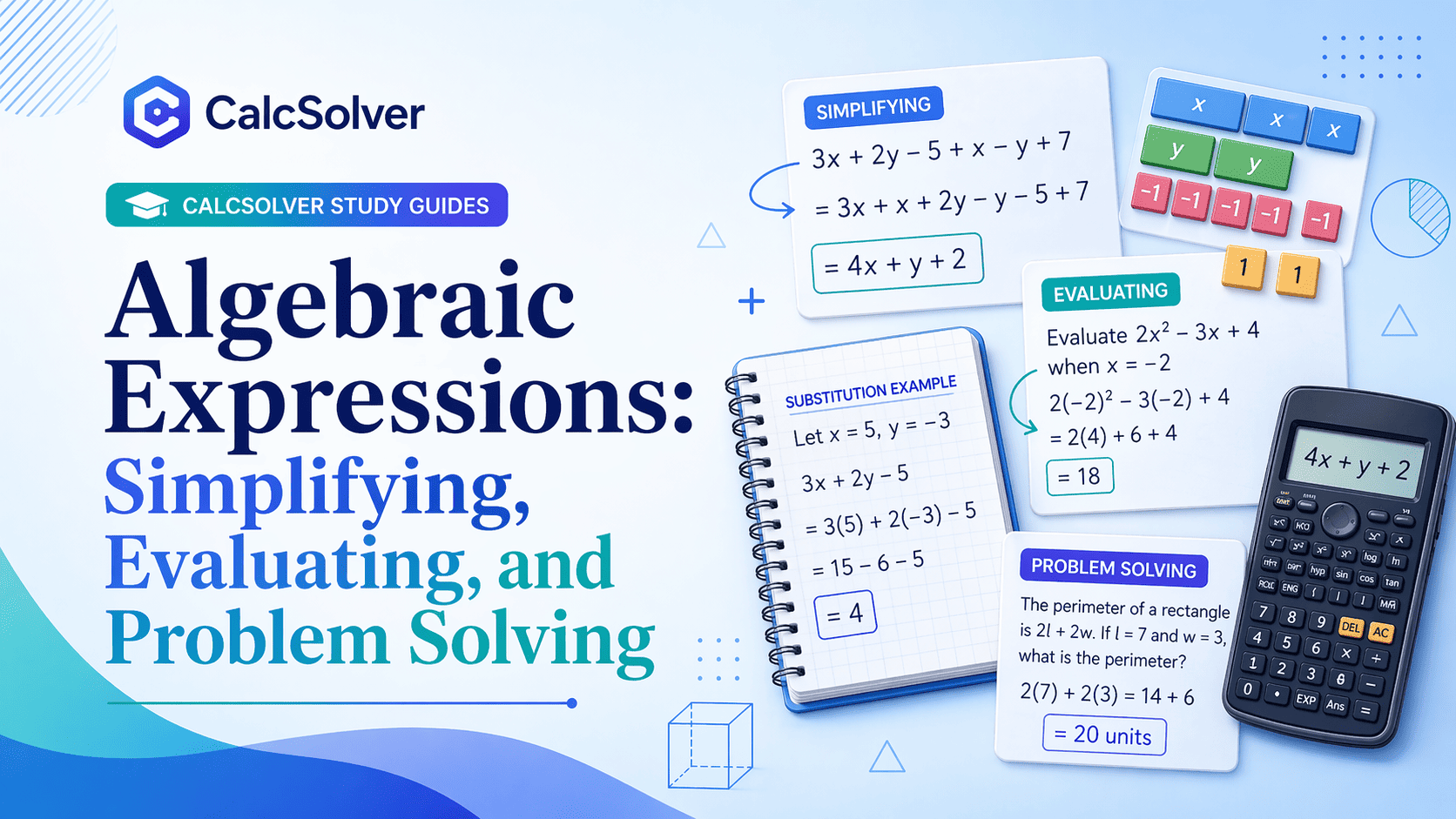
Algebraic Expressions: Simplifying, Evaluating, and Problem Solving
An algebraic expression is one of the first places where students move from arithmetic to symbolic thinking. It does not ask for a single number immediately. Instead, it describes a quantity that can be simplified, evaluated, or used to model a situation. Once that idea is clear, many later algebra topics become easier because equations, functions, and formulas all build from expressions.
The key shift is this: arithmetic focuses on finding an answer, while algebraic expressions often focus on representing structure. Students who miss that shift usually treat variables as annoying blanks. Students who understand it start seeing expressions as compressed descriptions of patterns.
Applicable Use Cases
Algebraic expressions appear when translating words into math, simplifying multi-step work, substituting values, or preparing to solve equations. They are also used in geometry formulas, finance word problems, and science relationships such as distance, speed, and time.
A student may see phrases like "five more than twice a number" or "the area of a rectangle with width x and length x + 3." Both of these naturally turn into expressions before they become anything else.
That is why expressions matter so early in algebra. They are the bridge between language and symbolic work. If the bridge is weak, every later chapter feels harder than it should.
Core Ideas
An expression combines constants, variables, and operations but has no equals sign. That is the main difference from an equation. Expressions can be simplified by combining like terms, distributing multiplication, or factoring. They can be evaluated by substitution once a variable value is known.
The main rules involved are order of operations, the distributive property, and the idea of like terms. Like terms must have the same variable part. So 3x + 2x = 5x, but 3x + 2y cannot be combined into one term.
A useful viewpoint is that simplification is not about making an expression shorter at all costs. It is about making the structure clearer. Sometimes expanded form is clearer. Sometimes factored form is clearer. The best form depends on the task you need to do next.
Worked Examples
Example 1: Simplify 2x + 5x - 3. Combine like terms to get 7x - 3.
Example 2: Expand 3(x + 4). Apply distribution: 3x + 12.
Example 3: Evaluate 3x^2 - 2x + 4 when x = 2. Substitute first: 3(4) - 4 + 4 = 12.
Example 4: Translate "five more than twice a number." If the number is x, the expression is 2x + 5.
Example 5: Simplify 4(x - 3) + 2x. Distribute to get 4x - 12 + 2x = 6x - 12.
Example 6: Evaluate carefully with a negative value. If x = -2, then x^2 becomes 4, but -x^2 becomes -4 unless parentheses change the meaning. This is why substitution should always be written with parentheses around negative replacements.
Common Mistakes
The most common expression mistake is combining unlike terms. Another is distributing incorrectly, especially with negative signs. Students also confuse an expression with an equation and try to "solve" something that has no equals sign. Order-of-operations mistakes are common too, especially when substitution is involved.
Another frequent issue is reading words too quickly. "Five less than twice a number" is not the same as "twice a number less five" unless the structure is handled correctly. Translation accuracy matters as much as computation.
Students also over-trust what looks shorter. Sometimes a shorter expression is not the more useful one. If the next step is substitution, an expanded form may be easier to handle. If the next step is solving or pattern recognition, a factored form may be better.
FAQ
Can an expression have fractions or radicals?
Yes. Expressions may include fractions, roots, and many other operations. The key idea is still that they represent quantities.
When does an expression become an equation?
It becomes an equation when you set it equal to something else.
Why does simplifying matter if the calculator can evaluate it anyway?
Because simplification reveals structure, reduces mistakes, and helps you see which next step makes sense.
Difference from Nearby Tools
Use the Algebra page for direct substitution and one-variable linear equation checks. Use the Fractions tool when the expression includes rational forms that need denominator work. Use the Scientific Calculator when you already know the correct expression and just want a numerical evaluation.
Study Advice
Before simplifying, ask what kind of terms you have. Before substituting, write parentheses around the replacement value if it is negative. Before translating a sentence, underline the operation words such as "more than," "less than," "times," and "per." These habits cut down a large percentage of early algebra mistakes.
Expressions stop feeling abstract once you connect them to real meanings. That is the point at which algebra becomes useful instead of symbolic memorization.
The long-term goal is to stop seeing expressions as random symbols and start seeing them as structured objects you can rewrite, compare, and interpret. That shift is one of the most important transitions in all of early algebra.
Applied learning context
How this topic appears in real coursework
In real classes, this topic usually appears inside mixed assignments instead of in isolation. Students may need to combine definitions, formulas, and interpretation in a single response, which is why practicing only one template answer is often not enough. A stronger routine is to check what the question is really asking, identify the required variables, then map the setup to the correct method before calculating.
Common reasoning traps and how to prevent them
The most frequent mistakes happen before arithmetic starts: reading symbols too quickly, mixing units, applying the wrong formula, or skipping assumptions. To avoid this, write a short pre-check line for each problem: identify known values, unknown values, constraints, and expected answer size. This one-minute habit prevents many avoidable errors and improves final answer quality more than repeated button pressing.
How to self-verify before submitting answers
After solving, verify by estimation and by method. Estimation checks whether the result is in a plausible range. Method checks whether each step still matches the original question intent. If either check fails, revise the setup first instead of retyping numbers. This approach builds transferable problem-solving skill, not just short-term answer accuracy.