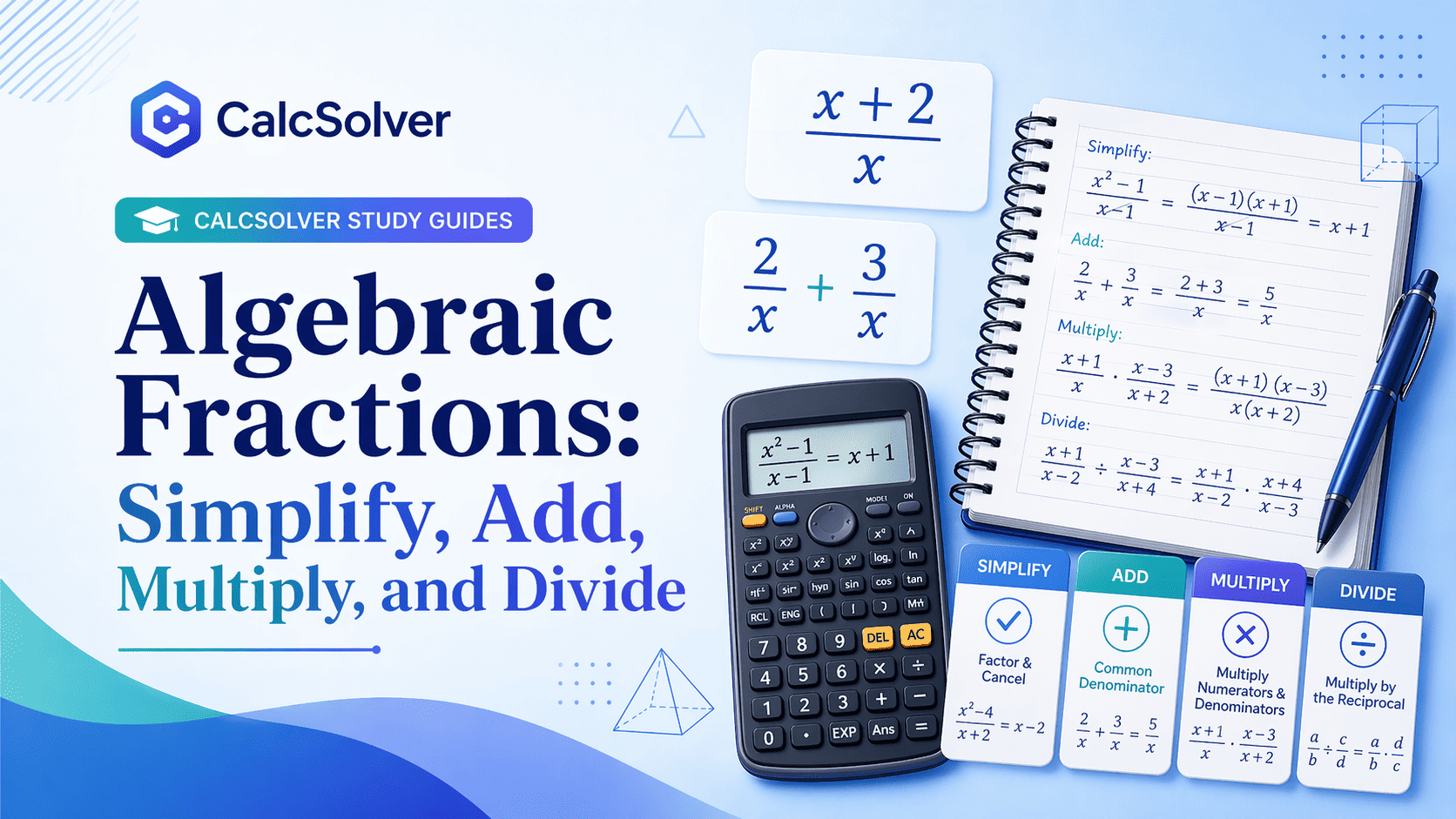
Algebraic Fractions: Simplify, Add, Multiply, and Divide
Algebraic fractions are fractions whose numerator or denominator contains algebraic expressions. They look more complicated than ordinary fractions, but the same structural rules still apply. You simplify by canceling common factors, add and subtract with a common denominator, and multiply or divide using the same fraction laws you already know from arithmetic.
The reason students find this topic difficult is not that it has brand-new rules. The real challenge is that it combines several older skills at once: factoring, sign control, denominator logic, and domain restrictions. Once those layers are separated, algebraic fractions become much more manageable.
Applicable Use Cases
Algebraic fractions appear in rational expressions, equation solving, graph domain restrictions, calculus preparation, and many textbook factoring problems. They are especially common when students simplify formulas or solve equations that come from geometry and physics.
The key shift from ordinary fractions is that factoring matters much more. Many algebraic-fraction problems are really disguised factoring problems written in fraction form. If you do not factor first, the expression may look impossible. If you do factor first, the path often becomes obvious.
Core Ideas
The most important rule is that cancellation works only with common factors, not with terms in a sum. That means you may simplify (x^2 - 4)/(x - 2) after factoring the numerator into (x - 2)(x + 2), but you may not cancel pieces of (x + 2)/(x + 3).
For addition and subtraction, algebraic fractions need a common denominator. For multiplication, factor first and then cancel. For division, invert the second fraction and multiply. Domain restrictions still matter, because any value that makes an original denominator zero must be excluded.
The deeper idea is that simplification changes form without changing value, but only on the allowed domain. That is why restrictions survive even after a common factor disappears from the simplified version. A removed factor may still represent a forbidden value from the original expression.
Worked Examples
Example 1: Simplify (x^2 - 4)/(x - 2). Factor the numerator: (x - 2)(x + 2). Cancel the common factor to get x + 2, with the restriction x != 2.
Example 2: Simplify (2x^2 + 4x)/(6x). Factor first: 2x(x + 2)/(6x). Cancel 2x to get (x + 2)/3, with x != 0.
Example 3: Add 1/x + 2/(x + 1). Use the denominator x(x + 1). Rewrite and combine: (x + 1 + 2x) / (x(x + 1)) = (3x + 1)/(x(x + 1)).
Example 4: Multiply (x/2) * (4/(x + 1)). Multiply and simplify: 4x / (2(x + 1)) = 2x/(x + 1).
Example 5: Divide (x + 1)/(x - 1) by (x^2 - 1)/(x + 2). Invert the second fraction and factor x^2 - 1 = (x - 1)(x + 1). Then simplify to get (x + 2)/(x - 1)^2, subject to the original restrictions.
Example 6: Why direct cancellation fails. In (x + 6)/(x + 3), you cannot cancel the x terms because they are parts of sums, not common factors. This is one of the most important non-examples in the topic.
Common Mistakes
The biggest mistake is canceling terms instead of factors. Another common error is forgetting domain restrictions after simplification. Students also make sign errors when adding fractions with unlike denominators, or forget to invert the second fraction during division.
Because these problems mix several skills, a small factoring mistake near the beginning can ruin the whole simplification. That is why checking structure matters more than rushing through arithmetic.
Students also sometimes cross-cancel during addition, which does not make sense. Cross-cancellation belongs to multiplication after the full factors are visible.
FAQ
Why do restrictions still matter after cancellation?
Because the original expression may still be undefined at certain values, even if the simplified form looks harmless.
Can I cross-cancel when adding fractions?
No. Cross-cancellation belongs to multiplication, not addition.
Is every algebraic fraction simplifiable?
No. Some are already in simplest form because numerator and denominator share no common factor.
What is the best first step on most problems?
Factor everything you can before trying to cancel, combine, or divide.
Difference from Nearby Tools
Use the Fractions page for ordinary numerical fractions. Use the Algebra page when the main task is substitution or linear solving. Use the Scientific Calculator for checking numerical values of original and simplified expressions at safe test points. This article focuses on the structure behind rational expressions rather than just the arithmetic.
Study Advice
Factor before doing anything else. That single habit turns many algebraic-fraction problems from confusing to routine. It also helps to test the original and simplified expression at one allowed value of x. If the two forms do not match, the simplification is wrong.
When students learn to see factor structure first, algebraic fractions stop looking like a special topic and start feeling like ordinary fraction rules applied carefully.
The best mental model is this: algebraic fractions are not new fraction rules. They are ordinary fraction rules operating inside a more demanding algebra environment. If you protect the factors and protect the restrictions, the topic becomes much more stable.
Applied learning context
How this topic appears in real coursework
In real classes, this topic usually appears inside mixed assignments instead of in isolation. Students may need to combine definitions, formulas, and interpretation in a single response, which is why practicing only one template answer is often not enough. A stronger routine is to check what the question is really asking, identify the required variables, then map the setup to the correct method before calculating.
Common reasoning traps and how to prevent them
The most frequent mistakes happen before arithmetic starts: reading symbols too quickly, mixing units, applying the wrong formula, or skipping assumptions. To avoid this, write a short pre-check line for each problem: identify known values, unknown values, constraints, and expected answer size. This one-minute habit prevents many avoidable errors and improves final answer quality more than repeated button pressing.
How to self-verify before submitting answers
After solving, verify by estimation and by method. Estimation checks whether the result is in a plausible range. Method checks whether each step still matches the original question intent. If either check fails, revise the setup first instead of retyping numbers. This approach builds transferable problem-solving skill, not just short-term answer accuracy.