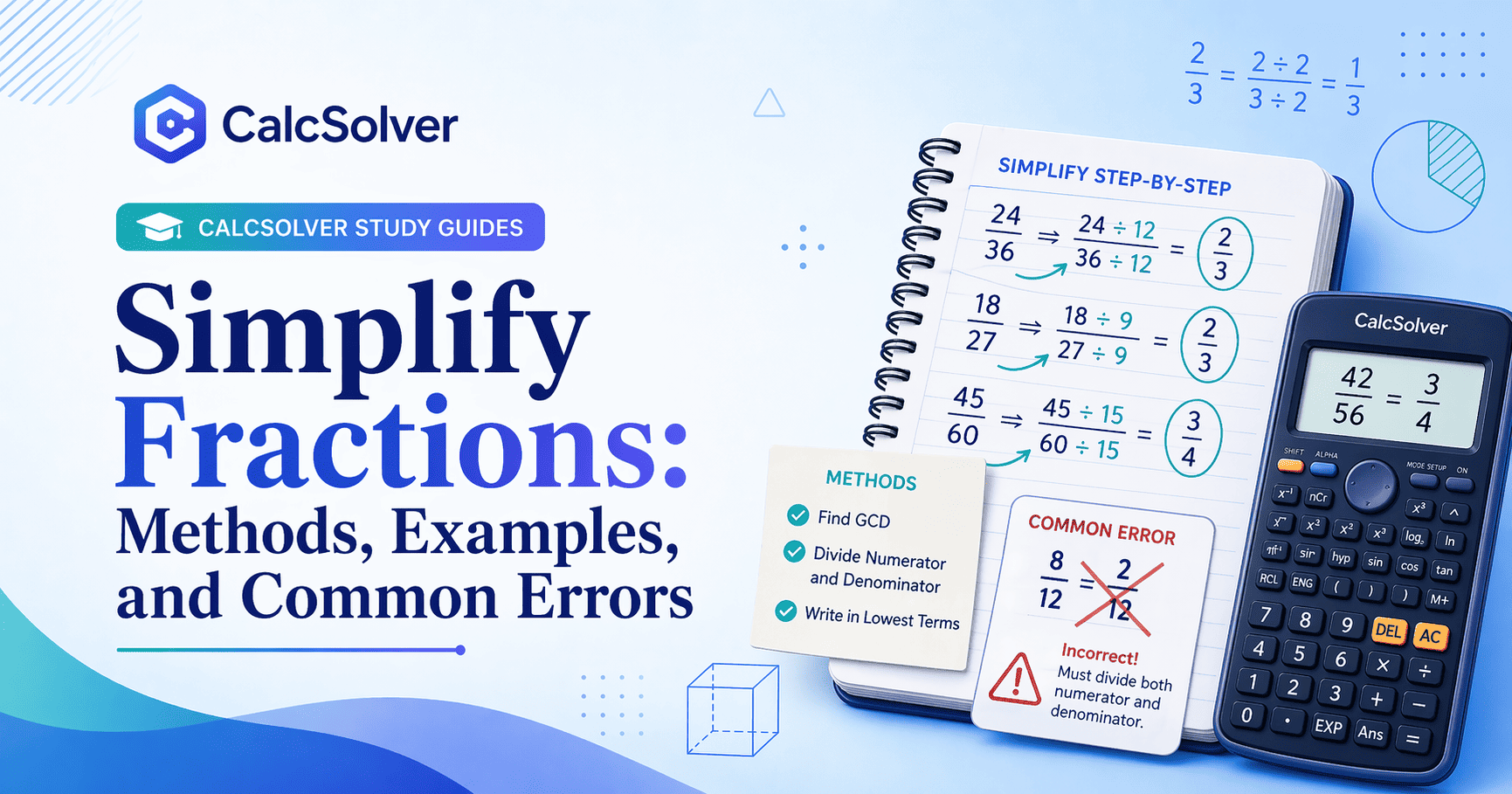
Simplify Fractions: Methods, Examples, and Common Errors
Fraction simplification is one of the earliest places where students meet the idea of equivalent forms. A simplified fraction does not change the value. It rewrites the same quantity in a clearer and easier-to-compare way. That is why teachers usually expect the final answer in lowest terms, and why simplification matters later in algebra, ratios, probability, and measurement.
The hidden lesson in fraction simplification is structural thinking. You are not just shrinking numbers. You are looking for a common factor that can be removed without changing the relationship. Students who understand that idea usually do better later with rational expressions and algebraic factoring, because they have already learned that equivalent form is different from changed value.
Applicable Use Cases
You simplify fractions when comparing portions, adding or subtracting with common denominators, converting percent to exact form, reducing measurement ratios, or turning an improper fraction into something more readable. In practical terms, recipes, maps, probability questions, and many school worksheets all use the same skill.
Even when a calculator can show a decimal, the fraction form may still be more useful. For example, 0.375 is readable, but 3/8 often communicates structure better in a math class or formula sheet.
Formula Principle
The core rule is simple: if you multiply or divide both the numerator and denominator by the same nonzero number, the value of the fraction stays the same. Simplifying means dividing by the greatest common divisor, or GCD. If the GCD of the numerator and denominator is 1, the fraction is already in simplest form.
This principle also explains equivalent fractions and common denominators. When adding fractions, you are not changing the value of each fraction. You are rewriting them so they share a denominator that makes the arithmetic possible.
A useful mental shortcut is to ask, "What factor is hiding inside both parts?" That question is better than randomly trying divisibility tests one at a time. In many fraction problems, the structure reveals itself quickly once you think in factors instead of digits.
Worked Examples
Example 1: Simplify 18/24. The GCD of 18 and 24 is 6. Divide both parts by 6: 18/24 = 3/4.
Example 2: Simplify 45/60. The GCD is 15. Divide top and bottom by 15: 45/60 = 3/4.
Example 3: Find an equivalent fraction for 2/3 with denominator 12. Multiply numerator and denominator by 4: 2/3 = 8/12.
Example 4: Add 1/6 + 1/8. The least common denominator is 24. Convert to 4/24 + 3/24 = 7/24. Since 7 and 24 share no common factor above 1, the final answer is already simplified.
Example 5: Convert 11/4 to a mixed number. Divide 11 by 4. The quotient is 2 and the remainder is 3, so the mixed-number form is 2 3/4.
Example 6: Simplify 36/54. The GCD is 18, so 36/54 = 2/3. This is a good example of why finding the largest common factor first reduces wasted steps.
Example 7: Simplify 8/12 carefully. Many students first reduce it to 4/6 and stop. But the GCD of 8 and 12 is 4, so the true lowest-terms result is 2/3. Partial simplification is still incomplete work.
Common Mistakes
The biggest fraction error is illegal cancellation. Students see something like (x + 2) / (x + 3) and try to "cancel x," but cancellation only works on common factors, not on pieces of a sum. Another mistake is adding both numerators and denominators directly, such as turning 1/2 + 1/3 into 2/5.
Negative signs also create trouble. A single negative can live in the numerator, denominator, or in front of the whole fraction, but it should not disappear during simplification. Mixed numbers are another trap: students may try to multiply with them directly instead of converting to improper fractions first.
Another common error is stopping after one reduction step without checking whether a shared factor still remains. Students sometimes believe "smaller numbers" automatically mean "simplest form," but the correct test is whether the GCD has become 1.
FAQ
Is a decimal answer enough?
Sometimes, but not always. Many school problems expect the simplified fraction because it preserves exact value and shows structure more clearly.
What is the difference between a GCD and an LCD?
The GCD simplifies one fraction by finding the largest common factor. The LCD helps combine two or more fractions by finding a shared denominator.
Do I always simplify after adding or subtracting fractions?
In most school settings, yes. Unless the question requests a specific denominator, simplify the final answer.
Difference from Nearby Tools
Use the Fractions Calculator for simplification, equivalent fractions, mixed-number conversion, and least common denominator checks. Use the Percent tool when the ratio is being expressed as parts per hundred. Use the Algebra page when fractions appear inside variable expressions and substitution tasks.
Learning Advice
Write the factor you are dividing by at each step. That visual discipline prevents illegal cancellation and dropped signs. It also helps to ask a quick self-check question: "Did I change the value, or just rewrite it?" If the answer is "rewrite it," then the numerator and denominator must have changed together.
Practice one simplification problem, one equivalent-fraction problem, and one common-denominator problem in the same session. Those three skills reinforce each other and turn fractions from a memorized topic into a connected system.
The larger viewpoint is that fractions reward slow structure and punish rushed intuition. When students stop trying to "eyeball" everything and start tracking factors explicitly, the topic usually becomes much easier.
Applied learning context
How this topic appears in real coursework
In real classes, this topic usually appears inside mixed assignments instead of in isolation. Students may need to combine definitions, formulas, and interpretation in a single response, which is why practicing only one template answer is often not enough. A stronger routine is to check what the question is really asking, identify the required variables, then map the setup to the correct method before calculating.
Common reasoning traps and how to prevent them
The most frequent mistakes happen before arithmetic starts: reading symbols too quickly, mixing units, applying the wrong formula, or skipping assumptions. To avoid this, write a short pre-check line for each problem: identify known values, unknown values, constraints, and expected answer size. This one-minute habit prevents many avoidable errors and improves final answer quality more than repeated button pressing.
How to self-verify before submitting answers
After solving, verify by estimation and by method. Estimation checks whether the result is in a plausible range. Method checks whether each step still matches the original question intent. If either check fails, revise the setup first instead of retyping numbers. This approach builds transferable problem-solving skill, not just short-term answer accuracy.