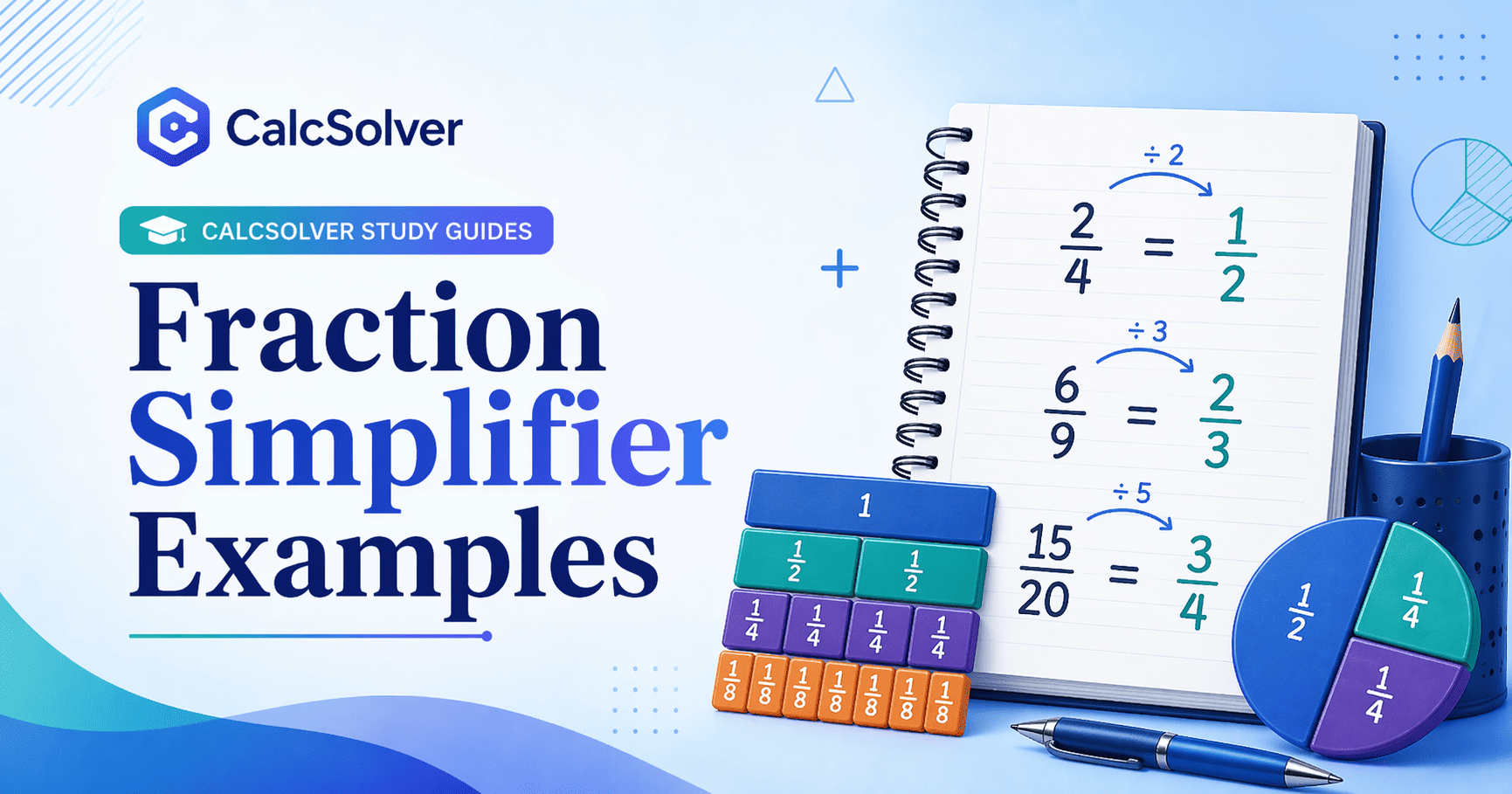
Fraction Simplifier Examples
Simplifying a fraction means rewriting it in lowest terms without changing its value. That definition sounds easy, but many students still make repeated mistakes because they memorize a move instead of understanding the reason behind the move. The real principle is not "keep dividing until it looks smaller." The real principle is that a fraction keeps the same value only when the numerator and denominator are changed by the same factor.
That is why good fraction examples matter. They show that simplification is not decoration. It is a way of making structure visible. A simplified fraction is easier to compare, easier to use in later algebra, and easier to interpret in measurement or ratio problems. When students skip this idea, they often treat simplification as optional cleanup. In fact, it is often the clearest form of the answer.
Applicable Use Cases
Fraction simplification appears in arithmetic, measurement, ratio reasoning, probability, geometry, percent conversion, and later algebra. A recipe ratio such as 4/8 is easier to understand as 1/2. A probability written as 12/18 becomes more readable as 2/3. In algebra, rational expressions depend on the same structural idea of canceling common factors.
This topic also matters because fractions are often used as exact answers when decimals would hide useful structure. If 18/24 simplifies to 3/4, that is not just shorter. It shows the relationship more clearly.
Core Ideas
The governing idea is the greatest common divisor, or GCD. If numerator and denominator share a common factor, you can divide both by that same factor and keep the value unchanged. If the GCD is 1, the fraction is already fully simplified.
The phrase "divide both by the same factor" is the non-negotiable rule. If you divide only the numerator or only the denominator, the value changes. That is no longer simplification. It is a different fraction.
There is also a useful judgment habit here: ask whether the fraction is already giving a recognizable ratio. Fractions like 50/100, 75/100, and 18/24 simplify into cleaner forms that are easier to interpret quickly. Simplification is partly about efficiency, but it is also about clarity.
Worked Examples
Example 1: 18/24 has GCD 6, so divide both parts by 6. The simplified fraction is 3/4. This is a classic example because the reduced form is familiar and easy to interpret.
Example 2: 12/16 has GCD 4, so it simplifies to 3/4. Comparing this with the first example shows how many different-looking fractions can represent the same value.
Example 3: 45/60 has GCD 15, so it also simplifies to 3/4. This is a good reminder that larger numbers do not change the logic. The same idea scales.
Example 4: 14/49 has GCD 7, so it simplifies to 2/7. Students who try to divide by 2 here get stuck. The better habit is to search for actual shared factors instead of forcing the same small number each time.
Example 5: 8/12 can be reduced to 4/6, but that is not the final answer. The GCD of 8 and 12 is 4, so the correct lowest-terms form is 2/3. This example matters because "partly simplified" is one of the most common student errors.
Example 6: 11/4 is already simplified because the GCD is 1. It cannot be reduced further, although it can be rewritten as the mixed number 2 3/4. Simplifying and changing form are related but not identical tasks.
Example 7: 36/54 has GCD 18, so it simplifies directly to 2/3. This example is useful because students often choose 6 first and then need extra steps. Using the GCD gives the cleanest route.
Common Mistakes
The most common error is dividing only the numerator or only the denominator. That changes the value, so the result is no longer equivalent to the original fraction.
Another common mistake is stopping too early, such as reducing 8/12 to 4/6 and thinking the work is done. If the numerator and denominator still share a factor, the fraction is not in lowest terms.
A third mistake is confusing simplification with decimal conversion. Writing 3/4 as 0.75 is a valid conversion, but it is not what fraction simplification means. Simplification stays in fraction form while reducing to the clearest equivalent ratio.
Students also overuse cancellation rules without checking whether they are canceling actual common factors. That becomes a major problem in later algebra, where only factors can cancel, not arbitrary terms.
FAQ
Do I always need the greatest common divisor first?
No, but it is the fastest way to reach lowest terms in one step and avoid partial simplification.
Can two different-looking fractions be equal?
Yes. That is exactly what equivalent fractions mean. Many different numerators and denominators can represent the same ratio.
Should I convert to decimals to simplify?
No. Simplification works directly with factors and is usually better kept in fraction form unless the problem explicitly asks for a decimal.
Why does simplification matter if my calculator can show a decimal?
Because simplified fractions preserve exact structure. In many school problems, that structure is more useful than a rounded decimal.
Difference from Nearby Tools
Use the Fractions page for direct simplification, mixed-number conversion, and LCD work. Use the Percent page when the same value needs to be expressed per hundred. Use the Scientific Calculator when you want to compare decimal approximations after simplifying. The key difference is that this article teaches the logic behind equivalent fractions, while the tools help you execute and verify that logic quickly.
Study Advice
Ask two questions every time: what is the greatest common divisor, and did I divide both parts by the same number? That checklist catches most errors immediately. It also helps to practice groups of examples that all simplify to the same final result, such as several fractions that become 3/4. That builds intuition for equivalence rather than isolated memorization.
The broader lesson is that fraction simplification is a structural skill. It trains you to notice shared factors, preserve value while changing form, and distinguish between a number that looks messy and a number that is conceptually clear. Those habits carry directly into algebra later on.
Applied learning context
How this topic appears in real coursework
In real classes, this topic usually appears inside mixed assignments instead of in isolation. Students may need to combine definitions, formulas, and interpretation in a single response, which is why practicing only one template answer is often not enough. A stronger routine is to check what the question is really asking, identify the required variables, then map the setup to the correct method before calculating.
Common reasoning traps and how to prevent them
The most frequent mistakes happen before arithmetic starts: reading symbols too quickly, mixing units, applying the wrong formula, or skipping assumptions. To avoid this, write a short pre-check line for each problem: identify known values, unknown values, constraints, and expected answer size. This one-minute habit prevents many avoidable errors and improves final answer quality more than repeated button pressing.
How to self-verify before submitting answers
After solving, verify by estimation and by method. Estimation checks whether the result is in a plausible range. Method checks whether each step still matches the original question intent. If either check fails, revise the setup first instead of retyping numbers. This approach builds transferable problem-solving skill, not just short-term answer accuracy.