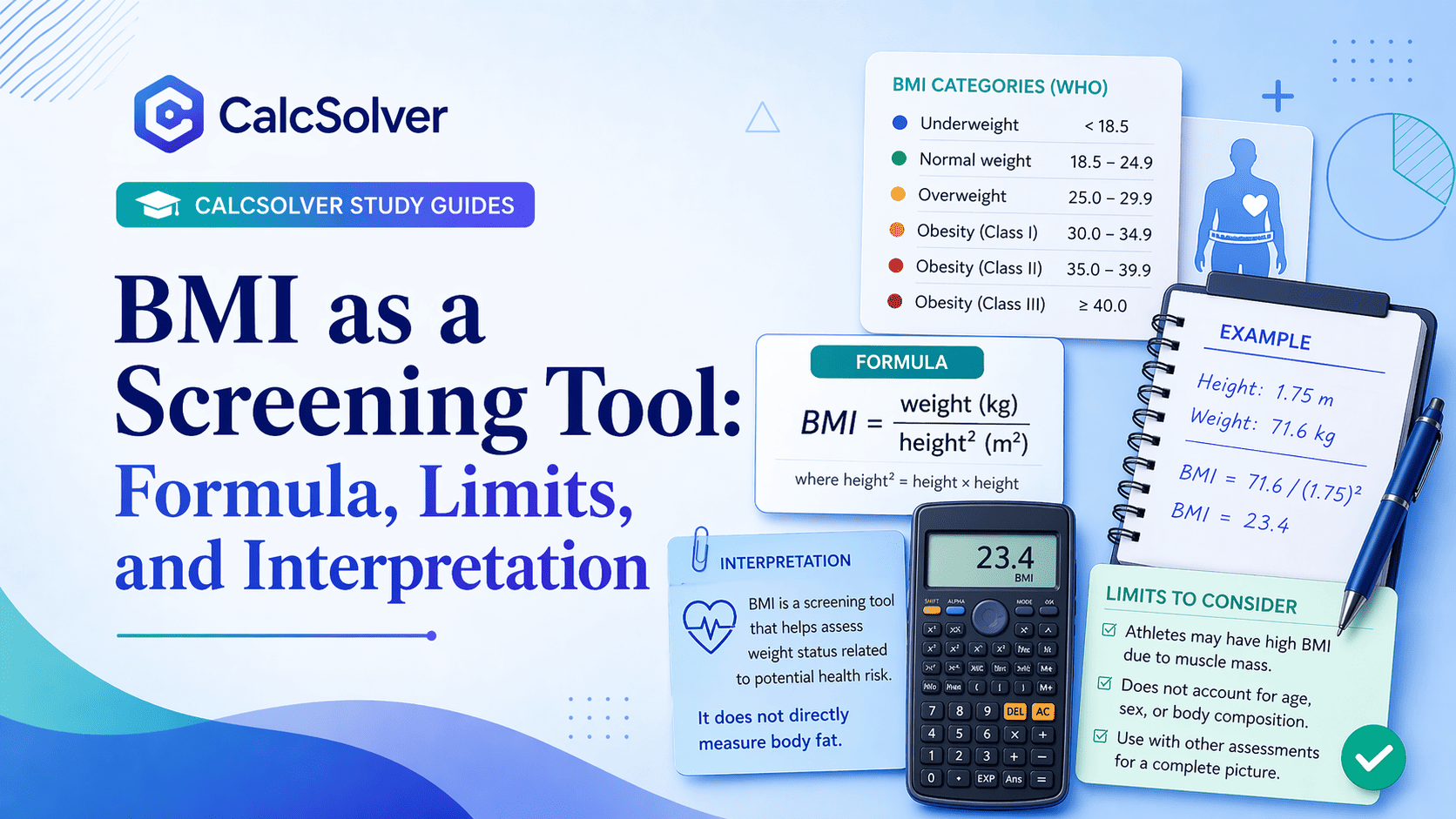
BMI as a Screening Tool: Formula, Limits, and Interpretation
BMI is one of the most common public-health numbers because it is easy to calculate from height and weight alone. That simplicity makes it useful for screening and broad comparisons, but it also creates the risk that readers over-interpret the number. BMI is best treated as a starting point, not a diagnosis.
That distinction matters. A screening tool is designed to flag patterns or categories that may deserve more attention. It is not designed to capture every detail of a person's health, body composition, or medical situation. Readers who understand that boundary use BMI more intelligently than readers who either trust it too much or dismiss it entirely.
Applicable Use Cases
BMI is useful in classroom health units, quick personal screening, public-health reports, and first-pass comparisons across large groups. It helps answer a narrow question: how does weight relate to height in a standardized way? It does not answer every health question, but it can point to whether further attention may be worth considering.
It is also useful because the same formula works across large groups, which is why organizations use it in charts and reports. The tradeoff is that population-level usefulness does not mean perfect individual accuracy.
Formula Principle
The metric formula is BMI = weight in kilograms / height in meters squared. The imperial version uses pounds and inches with a conversion constant: BMI = 703 * weight in pounds / height in inches squared.
The squared height in the denominator is important. It means small changes in height entry can shift BMI more than students expect. It also explains why unit mistakes produce wildly unrealistic numbers.
This is why BMI calculators must be handled carefully. A good tool can compute the arithmetic correctly, but the user still has to supply the correct measurement system and understand the limits of the result.
Worked Examples
Example 1: 68 kg and 1.72 m. Square the height: 1.72^2 = 2.9584. Then divide: 68 / 2.9584 = 22.99. That falls in the normal-weight category.
Example 2: 150 lb and 68 in. Use the imperial formula: 703 * 150 / 68^2. Since 68^2 = 4624, the BMI is about 22.8.
Example 3: 90 kg and 1.70 m. Height squared is 2.89. Then 90 / 2.89 = 31.14, which is in the obesity category under common adult cutoff systems.
Example 4: Height entry error. If someone enters 172 as meters instead of centimeters converted to meters, the result becomes meaningless. That is a unit error, not a health insight.
Example 5: Why interpretation needs context. Two people can share the same BMI while differing in age, muscle mass, body composition, and health status. The number is a ratio, not a complete profile.
Common Mistakes
The most common BMI mistake is mixing units, such as entering pounds where kilograms are expected or forgetting to convert centimeters into meters. Another mistake is treating BMI as a measure of body fat percentage or overall fitness, which it is not.
Readers also make interpretation mistakes. An athlete with high muscle mass may have a high BMI without the same health meaning as a sedentary person at the same number. Likewise, BMI categories for adults are not applied the same way to children and teens.
Another mistake is reading category boundaries as if they were exact personal verdicts. Screening categories are guidelines, not complete medical conclusions.
FAQ
Is BMI useless because it is imperfect?
No. It is still useful as a screening number. The correct conclusion is that it has limits, not that it has no value.
Can BMI diagnose health conditions?
No. It can suggest that more context may be needed, but diagnosis requires professional evaluation.
Why do adults and children use different interpretation methods?
Because growth and body development change with age. Child and teen interpretation often uses percentile-based charts rather than fixed adult cutoffs.
Why is BMI still used if it has limitations?
Because it is fast, inexpensive, standardized, and useful for broad screening even though it does not tell the whole story.
Difference from Nearby Tools
Use the BMI Calculator when you want a direct metric or imperial calculation. Use the Scientific Calculator if BMI appears inside a larger custom worksheet or class assignment. BMI is different from the loan and GPA tools because it is a screening ratio, not a planning average or repayment model.
Reading Advice
Read BMI categories as rough ranges, not personal verdicts. If you are studying the topic, focus first on unit handling and formula structure. Once the formula is stable in your mind, move on to the more important question: what can the number say, and what can it not say?
That second question is what turns BMI from a memorized formula into actual understanding.
The best reading habit is to keep both truths together: BMI has real public-health usefulness, and BMI has real limitations. Oversimplifying either direction makes the topic less useful.
Applied learning context
How this topic appears in real coursework
In real classes, this topic usually appears inside mixed assignments instead of in isolation. Students may need to combine definitions, formulas, and interpretation in a single response, which is why practicing only one template answer is often not enough. A stronger routine is to check what the question is really asking, identify the required variables, then map the setup to the correct method before calculating.
Common reasoning traps and how to prevent them
The most frequent mistakes happen before arithmetic starts: reading symbols too quickly, mixing units, applying the wrong formula, or skipping assumptions. To avoid this, write a short pre-check line for each problem: identify known values, unknown values, constraints, and expected answer size. This one-minute habit prevents many avoidable errors and improves final answer quality more than repeated button pressing.
How to self-verify before submitting answers
After solving, verify by estimation and by method. Estimation checks whether the result is in a plausible range. Method checks whether each step still matches the original question intent. If either check fails, revise the setup first instead of retyping numbers. This approach builds transferable problem-solving skill, not just short-term answer accuracy.