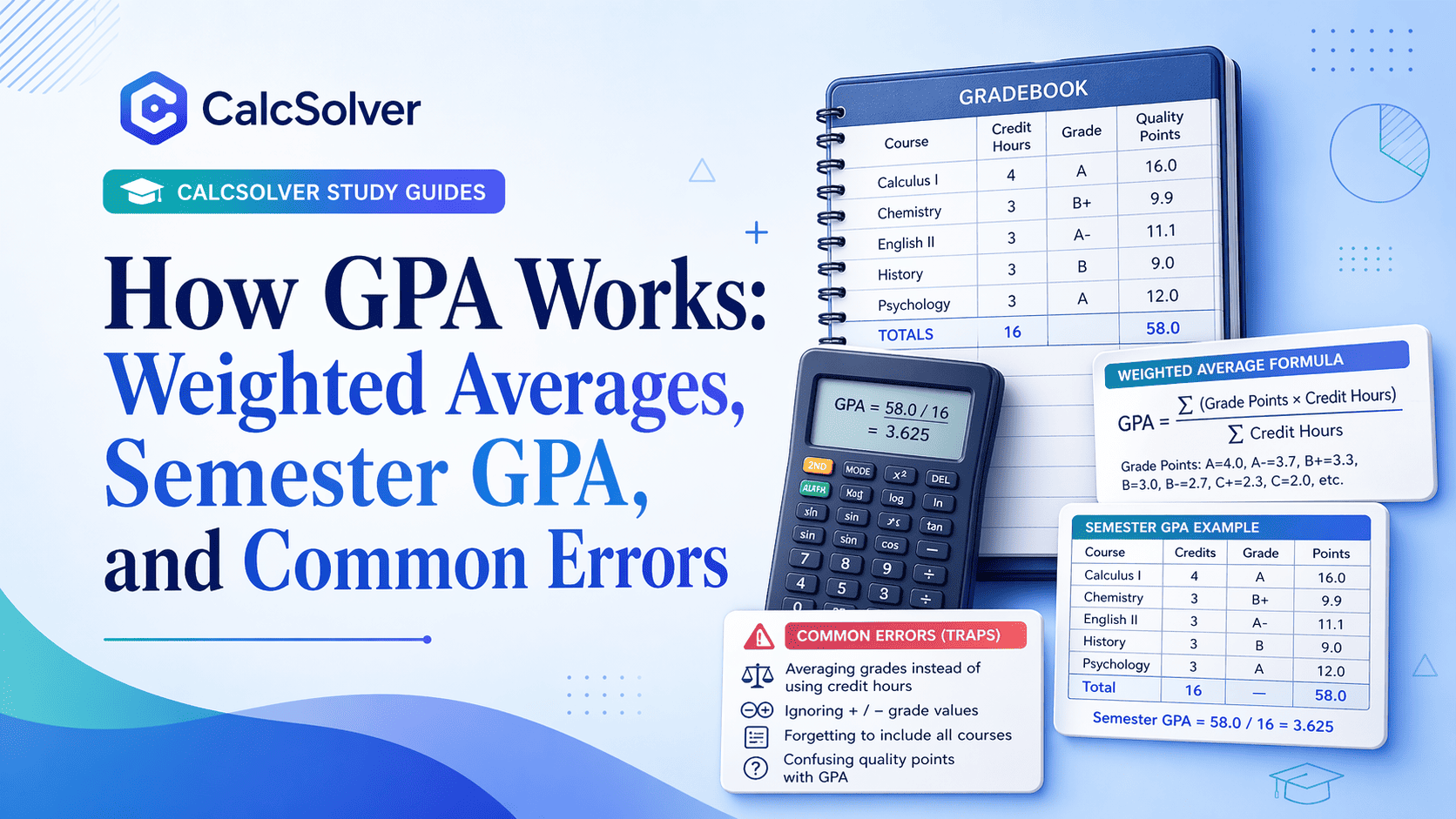
How GPA Works: Weighted Averages, Semester GPA, and Common Errors
GPA looks simple because it is reported as one number, but it is really a weighted average built from credits and grade points. That is why students often feel confused when the official GPA does not match a quick mental average of their classes. The number depends on the school's grading scale, course credits, and sometimes course level.
The phrase "weighted average" is the real center of the topic. Once students understand that GPA gives bigger influence to bigger credit values, many transcript surprises stop being surprising. The point is not to memorize one formula line. The point is to understand how the academic record is being summarized.
Applicable Use Cases
You calculate GPA when checking how one semester went, projecting a cumulative GPA after a new term, comparing weighted and unweighted performance, or planning scholarship and admission goals. It also matters when you want to know how much a single high-credit class can move your transcript.
This topic becomes especially important when students take mixed course loads. A one-credit lab and a four-credit lecture should not affect GPA equally. Once you understand that difference, GPA stops looking random and starts looking predictable.
Formula Principle
The core GPA formula is:
GPA = sum(grade points * credits) / sum(credits)
That is a weighted average because each class is multiplied by its credit value first. Unweighted GPA usually uses a standard 4.0 scale. Weighted GPA may add extra points for honors, AP, IB, or dual-enrollment classes, depending on the school. Semester GPA uses only the current term. Cumulative GPA includes all included graded credits on the transcript.
What makes GPA feel complicated is that the formula is stable but the policy inputs can change. Different schools may assign different values for plus/minus grades, repeated courses, advanced-course weighting, or pass/fail treatment. So the structure is simple even when the policy environment is not.
Worked Examples
Example 1: Standard semester GPA. A in 3 credits and B in 4 credits gives (4.0*3 + 3.0*4) / 7 = 24/7 = 3.43.
Example 2: Why direct averaging fails. If you simply average 4.0 and 3.0, you get 3.5. That is wrong because the courses do not carry equal credit weight.
Example 3: Weighted GPA. Suppose an honors A counts as 5.0 in 3 credits and a standard B counts as 3.0 in 4 credits. Then the weighted GPA is (5*3 + 3*4) / 7 = 27/7 = 3.86.
Example 4: Cumulative projection. If you already have 30 credits at a 3.2 GPA, that means 96 quality points. Add 15 new credits at a 3.6 GPA, which gives 54 more quality points. Total: 150 quality points over 45 credits, so the new cumulative GPA is 150/45 = 3.33.
Example 5: Transcript planning. If a student wants to move a cumulative GPA slowly upward, improving grades in high-credit classes usually matters more than obsessing over small-credit electives.
Example 6: Why large credit pools move slowly. A cumulative GPA built from many completed credits becomes harder to shift dramatically because each new term is entering a larger denominator.
Common Mistakes
The most common GPA mistake is averaging letters or semester GPAs directly instead of using credits. Another mistake is using the wrong grade scale, such as assuming an A- is 3.7 when a school uses 3.67 or another variation. Students also mix weighted and unweighted numbers without labeling them clearly.
Another major issue is assuming all courses count. Some schools exclude pass/fail, withdrawals, transfer credit, repeated courses, or local policy exceptions. The calculator can estimate the math, but official policy still determines the final transcript number.
Students also sometimes panic over a single course without checking its actual credit weight. A disappointing grade matters, but its effect depends on where it sits in the larger credit structure.
FAQ
Is semester GPA the same as cumulative GPA?
No. Semester GPA covers one term only. Cumulative GPA includes all included graded credits on the record.
Can I compare my GPA with someone from another school?
Only carefully. Schools may use different scales, weighting policies, and transcript rules.
Does one bad class ruin a GPA forever?
Not necessarily. The impact depends on how many credits you already have and how many future credits can offset the result.
Difference from Nearby Tools
Use the GPA Calculator for direct GPA estimates and cumulative projections. Use the Percent tool if you first need to understand percentages in a grading context. Use the Scientific Calculator if GPA is only one part of a larger planning worksheet or custom calculation.
Learning Advice
Keep a running list of classes, credits, and grade points while the semester is still active. Students make fewer GPA mistakes when they track quality points instead of waiting until finals week and trying to reconstruct everything from memory.
It also helps to solve one term manually before relying on a calculator. Once you understand the weighted-average structure, GPA stops feeling mysterious and becomes a planning tool you can actually use.
The most useful long-term habit is to stop asking only "what is my GPA?" and start asking "what is driving my GPA?" That question leads to much better planning decisions.
Applied learning context
How this topic appears in real coursework
In real classes, this topic usually appears inside mixed assignments instead of in isolation. Students may need to combine definitions, formulas, and interpretation in a single response, which is why practicing only one template answer is often not enough. A stronger routine is to check what the question is really asking, identify the required variables, then map the setup to the correct method before calculating.
Common reasoning traps and how to prevent them
The most frequent mistakes happen before arithmetic starts: reading symbols too quickly, mixing units, applying the wrong formula, or skipping assumptions. To avoid this, write a short pre-check line for each problem: identify known values, unknown values, constraints, and expected answer size. This one-minute habit prevents many avoidable errors and improves final answer quality more than repeated button pressing.
How to self-verify before submitting answers
After solving, verify by estimation and by method. Estimation checks whether the result is in a plausible range. Method checks whether each step still matches the original question intent. If either check fails, revise the setup first instead of retyping numbers. This approach builds transferable problem-solving skill, not just short-term answer accuracy.