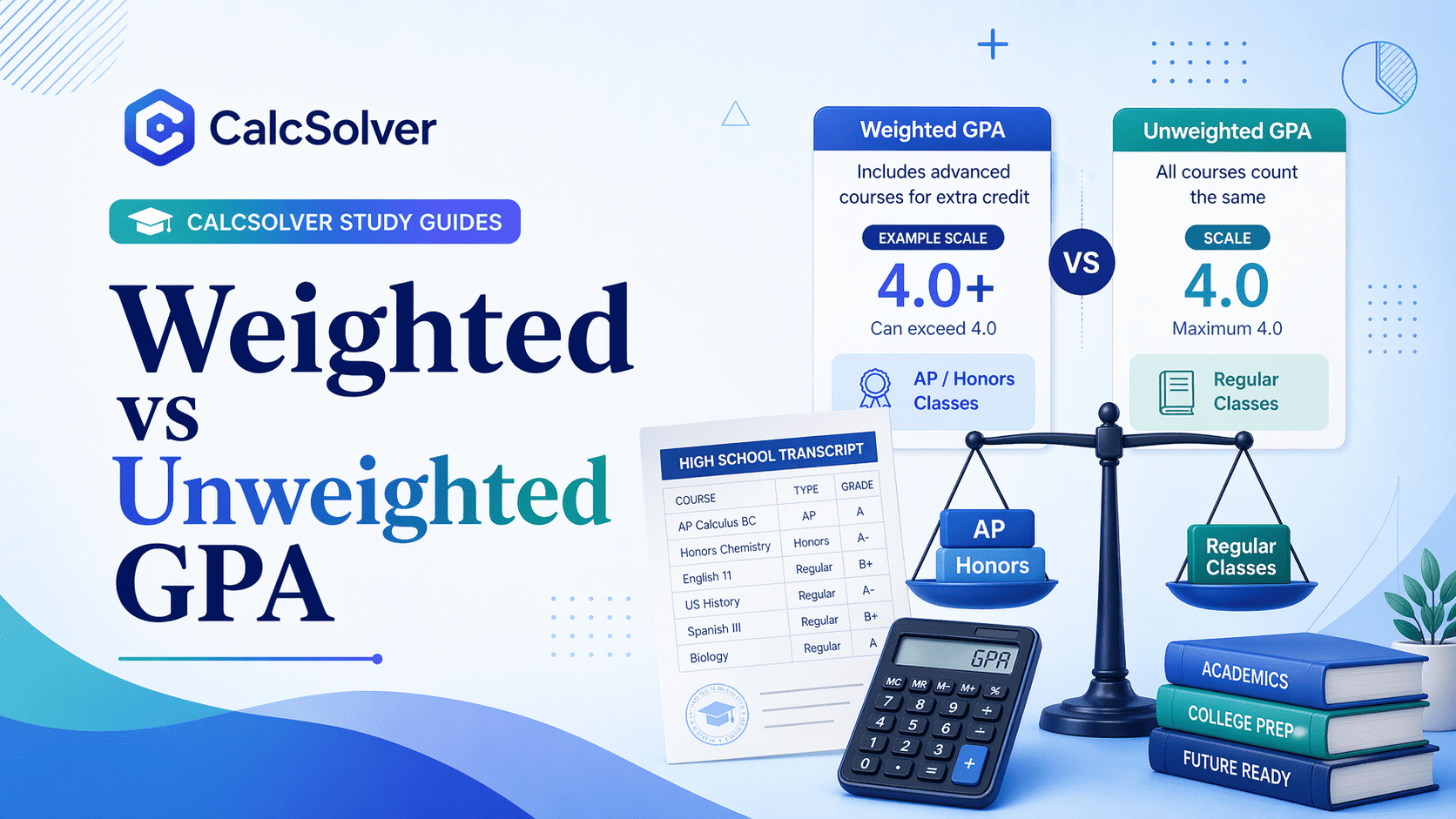
Weighted vs Unweighted GPA
Weighted and unweighted GPA are two different summaries of academic performance. They are related, but they are not interchangeable. Students often panic when both numbers appear on the same transcript because they assume one of them must be the "real" GPA. That is the wrong question. The better question is what each number is trying to summarize.
Unweighted GPA tries to describe grades on a standard scale without adding bonus value for course difficulty. Weighted GPA tries to preserve the grade information while also acknowledging course rigor. Neither number is automatically better. Each highlights a different feature of the academic record. If you compare them without context, you can draw the wrong conclusion very quickly.
Applicable Use Cases
This comparison matters when students evaluate transcript strength, compare scholarship targets, discuss admissions competitiveness, or try to understand why two schools report very different GPA numbers for similar grades. It also matters whenever a student wonders why taking advanced courses can make the GPA picture look stronger in one format and weaker in another.
Weighted versus unweighted GPA is especially important when comparing students across different schools. Two transcripts can both say "weighted GPA," but if one school uses a 4.5 cap and another uses a 5.0 cap, the numbers are not directly comparable. The label alone is not enough. The scale and the school policy matter.
Core Ideas
Unweighted GPA usually treats the standard grade scale as fixed, often capping an A at 4.0 regardless of course difficulty. Weighted GPA may add extra points for honors, AP, IB, or dual-enrollment coursework. That means the same letter grade can contribute differently depending on course level and school policy.
The most important principle is that GPA is a summary, not the full story. A single number compresses many classes, many credit values, and sometimes many policy rules into one line. That makes GPA useful, but it also makes GPA easy to misunderstand. A transcript with a lower unweighted GPA may still reflect stronger academic rigor if the student took harder courses. A higher weighted GPA may look impressive until you realize the school uses a scale that cannot be compared directly to another district.
The deeper point is that numbers always inherit the rules that produced them. Weighted GPA is not an objective universal measure. It is a local policy output. That is why admissions offices often read the transcript itself instead of trusting GPA alone.
Worked Examples
Example 1: An A in a standard class may count as 4.0 unweighted and 4.0 weighted if the school gives no bonus for that course level.
Example 2: An A in an honors class may count as 4.0 unweighted but 4.5 or 5.0 weighted depending on the school system. The grade is the same, but the weighted summary changes because the course difficulty is treated differently.
Example 3: Student A takes mostly regular classes and earns straight As. Student B takes several advanced classes and earns a mix of As and Bs. Student A may have a higher unweighted GPA, while Student B may have a higher weighted GPA. Neither number is wrong. They are describing different aspects of performance.
Example 4: Two schools both report weighted GPA, but one caps at 4.5 and the other at 5.0. A 4.4 at one school and a 4.4 at another school may not mean the same thing at all. This is why raw weighted GPA is weak for cross-school comparison without policy context.
Example 5: A college may review both the reported GPA and the transcript because course rigor matters alongside the final number. In practice, the admissions decision often relies on the pattern, not just the summary score.
Example 6: A student might worry that a lower unweighted GPA means their transcript looks weaker. In reality, a reader who understands course rigor may view a slightly lower unweighted GPA in a demanding schedule as stronger than a perfect GPA built only from easier classes.
Common Mistakes
The biggest mistake is comparing weighted and unweighted GPA as if they were the same measurement. They are not. One emphasizes grades on a standard scale. The other tries to incorporate rigor through bonus values.
Another mistake is assuming every school weights advanced classes the same way. Some schools add 0.5, some add 1.0, some use different rules for AP versus honors, and some schools publish multiple GPA versions at once. If you do not know the policy, the number alone can mislead you.
Students also sometimes treat weighted GPA as more "real" than unweighted GPA. That is not a strong way to think about it. Each number is real inside the policy that created it. The better question is what information each number includes and what it leaves out.
A final mistake is ignoring credits. GPA is not only about course level. It is also about how much weight each class carries in the transcript calculation. Credit structure and weighting policy work together.
FAQ
Which GPA matters more?
That depends on the school, scholarship, or program reviewing the record. Many readers consider both, plus the transcript itself.
Can two students with the same unweighted GPA look different academically?
Yes. Their course rigor may be very different, and that difference can matter a lot in context.
Does weighted GPA always mean a student is stronger?
Not automatically. Context, scale, course mix, and school policy all matter.
Why do colleges look beyond GPA?
Because GPA is a compressed summary. It cannot show every detail about rigor, grade trend, or school-specific policy on its own.
Difference from Nearby Tools
Use the GPA Calculator to estimate both weighted and unweighted outcomes on a planned course list. Use How to Calculate GPA Step by Step for the weighted-average method underneath GPA math. Use the Scientific Calculator only if you are building a custom GPA expression by hand. This article is about interpretation, not just arithmetic.
Study Advice
Whenever you discuss GPA, label the number clearly: weighted or unweighted. That single habit prevents a large amount of confusion. It also helps to check your school handbook before assuming how AP, IB, honors, or dual-enrollment classes are treated. Policies differ more than students expect.
The broader lesson is that GPA should be read as evidence, not as a complete identity. A transcript is stronger when you understand what the numbers mean, what they leave out, and what kind of story they tell together. Once students see weighted and unweighted GPA as two different lenses rather than competing truths, the topic becomes much easier to reason about.
Applied learning context
How this topic appears in real coursework
In real classes, this topic usually appears inside mixed assignments instead of in isolation. Students may need to combine definitions, formulas, and interpretation in a single response, which is why practicing only one template answer is often not enough. A stronger routine is to check what the question is really asking, identify the required variables, then map the setup to the correct method before calculating.
Common reasoning traps and how to prevent them
The most frequent mistakes happen before arithmetic starts: reading symbols too quickly, mixing units, applying the wrong formula, or skipping assumptions. To avoid this, write a short pre-check line for each problem: identify known values, unknown values, constraints, and expected answer size. This one-minute habit prevents many avoidable errors and improves final answer quality more than repeated button pressing.
How to self-verify before submitting answers
After solving, verify by estimation and by method. Estimation checks whether the result is in a plausible range. Method checks whether each step still matches the original question intent. If either check fails, revise the setup first instead of retyping numbers. This approach builds transferable problem-solving skill, not just short-term answer accuracy.