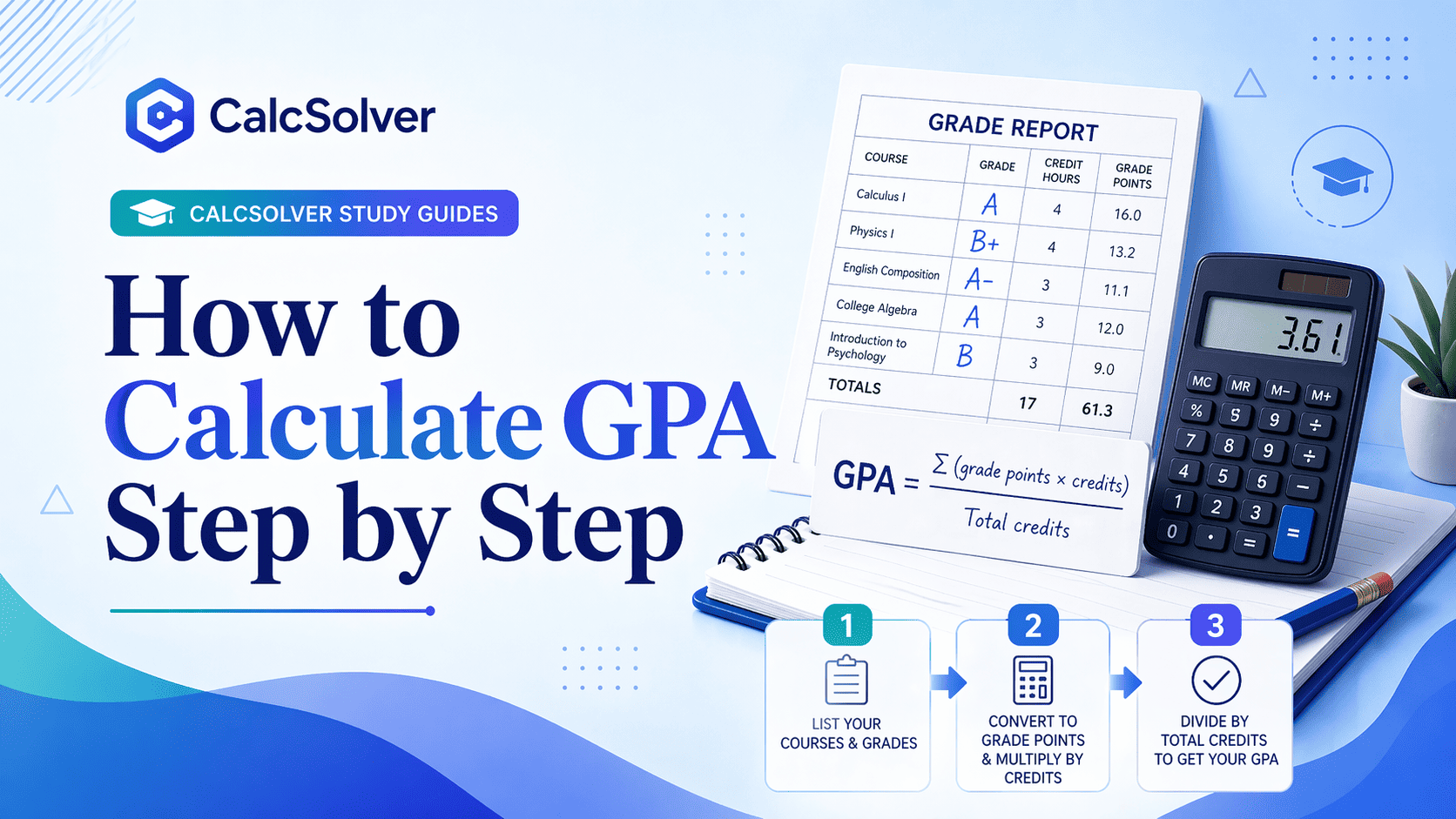
How to Calculate GPA Step by Step
GPA calculation feels confusing when students see only the final number on a transcript. In reality, the structure is straightforward once you separate grades, grade points, and credits. The key idea is that GPA is a weighted average, not a plain average of class letters. That one sentence explains why a three-credit A and a one-credit C do not simply "average out" the way students first expect.
What makes GPA confusing is not the formula itself. It is the policy layer around the formula. Schools may use different scales, different weighting rules, and different treatment for pass/fail, repeated, or transfer courses. That is why a good GPA article needs both arithmetic and judgment. The arithmetic tells you how GPA works. The judgment tells you what the number can and cannot mean.
Applicable Use Cases
You calculate GPA when checking term performance, projecting cumulative GPA, planning scholarship targets, deciding how much one course may influence the record, or comparing weighted and unweighted outcomes. It is also useful when students want to understand why one disappointing grade did not lower the average as much as expected, or why a high-credit course changed the result more than several small assignments.
GPA planning is valuable because it turns vague anxiety into visible structure. Once credits and grade points are written out, the transcript stops feeling random. You can see which courses carry the most weight and which outcomes are still recoverable.
Core Ideas
The process is: convert each grade into grade points, multiply by course credits, add those quality points, and divide by total graded credits. That is why GPA changes more when a course carries more credits. Semester GPA uses only one term. Cumulative GPA includes all included graded credits on the record.
This is the weighted-average idea: classes do not all count equally unless they all have the same credits. Students who average letters or average semester GPAs directly usually get the wrong answer because they ignore this weighting structure.
Another important principle is that GPA math is exact only after school policy is defined. Some schools exclude pass/fail, some replace old grades after repeats, some publish both weighted and unweighted versions, and some assign special point values to honors or AP classes. So the formula is stable, but the inputs can vary.
Worked Examples
Example 1: A in 3 credits and B in 4 credits gives (4.0*3 + 3.0*4)/7 = 24/7 = 3.43. This is the clearest example of why credits matter.
Example 2: A in 4 credits and C in 1 credit does not average to 3.0 by plain intuition. The weighted GPA is (4.0*4 + 2.0*1)/5 = 18/5 = 3.6. The heavier course dominates because it carries more credits.
Example 3: If you already have 30 credits at 3.2 GPA and add 15 credits at 3.6 GPA, the new cumulative GPA is (30*3.2 + 15*3.6)/45 = 150/45 = 3.33. This shows that cumulative GPA moves more slowly as the credit pool becomes larger.
Example 4: A weighted honors class may contribute more than a standard class with the same letter if the school policy allows extra grade points. That changes the total quality points before division.
Example 5: Repeated or pass/fail courses may not count the same way, which is why school rules still matter even when the formula is clear.
Example 6: A student with many completed credits may see only a small GPA change after one strong term. That is not evidence the term "did not matter." It reflects the mathematics of averaging over a larger denominator.
Common Mistakes
The main mistake is averaging letters or semester GPAs directly instead of using credits and quality points. Another is using the wrong grade scale. A third is mixing weighted and unweighted GPA without labeling them, which leads to bad comparisons and unnecessary panic.
Another common issue is forgetting that official GPA policies may exclude some categories of courses. The arithmetic may be right while the transcript assumption is wrong. Students also overreact to single grades without checking the credit weight. A low grade in a one-credit class does not affect GPA the same way as a low grade in a four-credit course.
The final mistake is treating GPA as a moral summary instead of a numerical summary. GPA is useful, but it does not capture rigor, trend, improvement, or context by itself.
FAQ
Is GPA always on a 4.0 scale?
No. Many schools publish both weighted and unweighted scales, and some use additional local rules.
Does every class count equally?
No. Credits and school policy determine the weight.
Why does one bad grade sometimes have less impact than expected?
Because GPA depends on the total credit pool, not just one class in isolation.
Why is cumulative GPA harder to change over time?
Because more completed credits create a larger denominator, so each new term has a smaller proportional effect.
Difference from Nearby Tools
Use the GPA Calculator for direct semester and cumulative estimates. Use Weighted vs Unweighted GPA when the main issue is comparing systems rather than calculating. Use the Percent tool only when a school first reports raw percentages and you need to think about numeric grading context. This article focuses on the logic under the calculator, not just the output.
Study Advice
Track credits and quality points during the term, not only after finals. That habit makes GPA planning easier and reduces panic when one assignment changes a projected grade. It also helps to do one full GPA calculation by hand so you understand the structure before relying on any tool.
The larger lesson is that GPA becomes less stressful once it becomes visible. When students write out credits, scale, weighting policy, and cumulative totals, the number stops feeling arbitrary. Good planning does not guarantee the GPA you want, but it does replace guesswork with a map.
Applied learning context
How this topic appears in real coursework
In real classes, this topic usually appears inside mixed assignments instead of in isolation. Students may need to combine definitions, formulas, and interpretation in a single response, which is why practicing only one template answer is often not enough. A stronger routine is to check what the question is really asking, identify the required variables, then map the setup to the correct method before calculating.
Common reasoning traps and how to prevent them
The most frequent mistakes happen before arithmetic starts: reading symbols too quickly, mixing units, applying the wrong formula, or skipping assumptions. To avoid this, write a short pre-check line for each problem: identify known values, unknown values, constraints, and expected answer size. This one-minute habit prevents many avoidable errors and improves final answer quality more than repeated button pressing.
How to self-verify before submitting answers
After solving, verify by estimation and by method. Estimation checks whether the result is in a plausible range. Method checks whether each step still matches the original question intent. If either check fails, revise the setup first instead of retyping numbers. This approach builds transferable problem-solving skill, not just short-term answer accuracy.