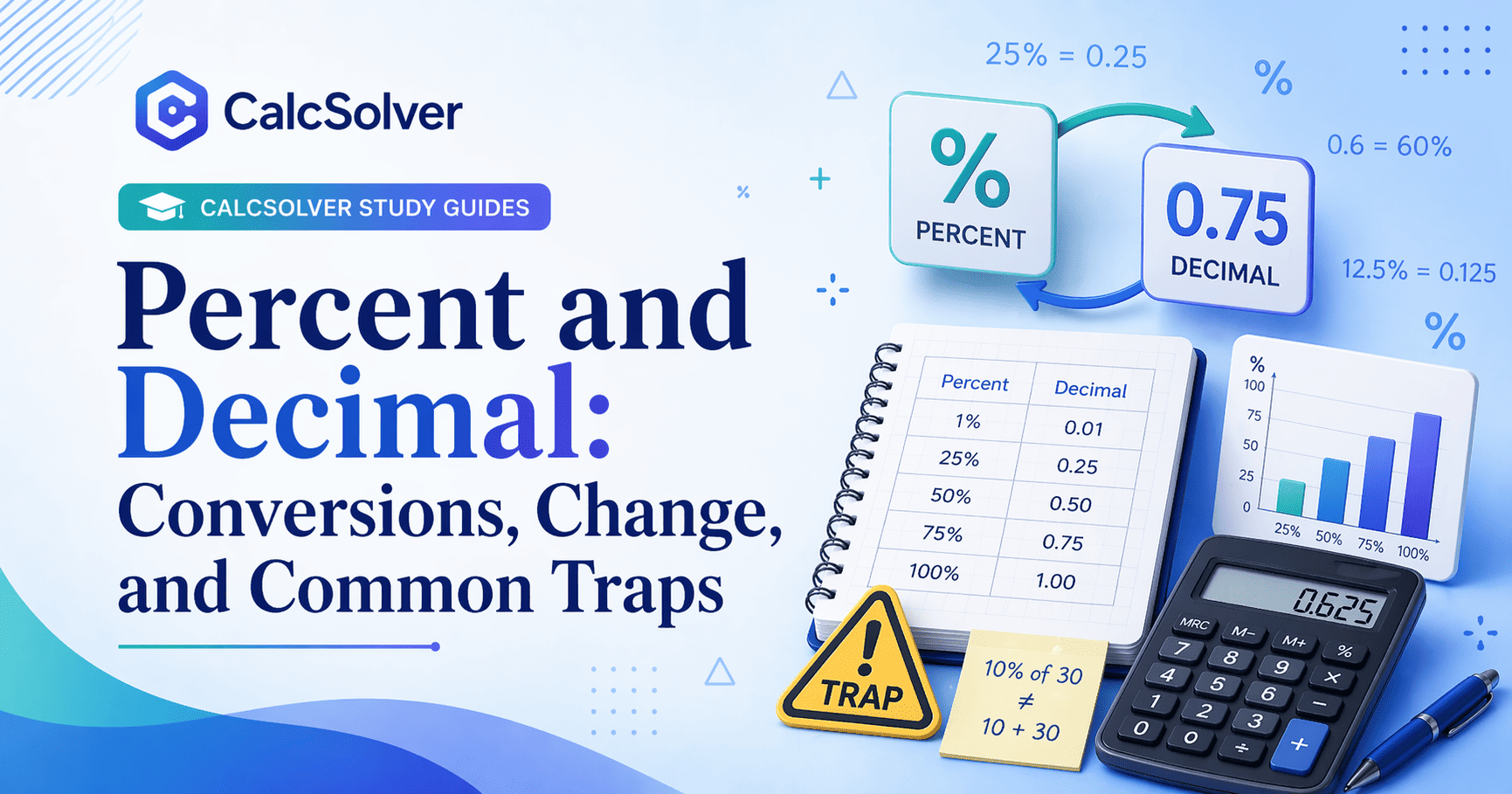
Percent and Decimal: Conversions, Change, and Common Traps
Percent and decimal are two ways of expressing the same part-to-whole relationship. That sounds simple, but percent problems become confusing when students treat every question as if it required the same operation. Sometimes the task is a direct conversion. Sometimes it is "find a percent of a number." Sometimes it is measuring percent change between an original value and a new value. Those tasks are related, but they are not interchangeable. Learning to separate them is the first real skill in this topic.
A thin percent lesson usually stops at "move the decimal two places." The problem is that real percent questions are not all conversion questions. Strong percent thinking requires a decision framework: what whole am I measuring against, am I converting or comparing, and what rough answer would make sense before I calculate? Once those questions become routine, percent work becomes much more reliable.
Applicable Use Cases
Percent and decimal conversions appear in grades, discounts, taxes, tips, survey summaries, lab reports, growth rates, and personal finance examples. If you read that a class average was 84%, a product was discounted 25%, or a loan rate is 4.5%, you are already working with values that become easier to calculate once they are translated into decimal form.
This topic matters most when words and numbers mix together. A sentence like "increase by 15%" becomes a multiplier of 1.15. A sentence like "15% of 80" becomes 0.15 * 80. A sentence like "from 80 to 92" is not a direct conversion at all. It becomes a percent-change problem. If you do not identify the task type first, the arithmetic may still look polished while the logic is wrong.
That is why percent is more than a school chapter. It is a language for comparison. Once you understand what the percentage is comparing, the formula usually becomes much easier to choose.
Formula Principles
A percent literally means "per hundred." That is why converting percent to decimal means dividing by 100, and converting decimal to percent means multiplying by 100. This is not just a notation trick. It reflects the underlying ratio idea that percent is based on a denominator of 100.
Three formulas cover most school-level percent problems:
- Percent to decimal: p% = p / 100
- Percent of a number: (p / 100) * base
- Percent change: ((new - old) / old) * 100
The third formula is where many mistakes happen because the denominator must be the original value. That denominator tells you what whole the change is being measured against. If a value rises from 80 to 92, the increase is 12, but the percentage meaning comes from asking "12 out of what original whole?" The answer is 80, not 92.
There is also a useful shortcut for real-world work: translate common phrases into multipliers. "Increase by 8%" means multiply by 1.08. "Decrease by 8%" means multiply by 0.92. "Keep 35% of the amount" means multiply by 0.35. Thinking in multipliers is often faster than rebuilding the logic from scratch each time.
Worked Examples
Example 1: Convert 75% to a decimal. Divide by 100. 75 / 100 = 0.75. This is a direct conversion problem, not a percent-change problem.
Example 2: Convert 0.08 to a percent. Multiply by 100. 0.08 * 100 = 8%. This matters when the calculator gives a decimal answer but the question expects a percent statement.
Example 3: Find 12% of 250. Convert 12% to 0.12, then multiply: 0.12 * 250 = 30. So 12% of 250 is 30. The phrase "of 250" tells you the base.
Example 4: A score rises from 80 to 92. The change is 12. Divide by the original 80: 12 / 80 = 0.15. Multiply by 100 to get 15%. The score increased by 15%.
Example 5: A shirt is discounted 25% from 60 dollars. One method is to compute the discount directly: 0.25 * 60 = 15, then subtract to get 45. Another method is to use the multiplier view: keeping 75% means 60 * 0.75 = 45. The second method is often easier in multi-step shopping problems.
Example 6: A price goes up 20% and then down 20%. Start with 100. After the increase: 100 * 1.20 = 120. After the decrease: 120 * 0.80 = 96. You do not return to 100 because the second percent applies to a different base.
Example 7: From 40% to 50% on a chart. This is an increase of 10 percentage points, but a 25% percent increase relative to the original 40%. Distinguishing percentage points from percent change is essential in statistics and data interpretation.
Common Mistakes
The most common mistake is moving the decimal the wrong way. Students sometimes treat 5% as 0.5 instead of 0.05. A fast correction habit is to ask whether the answer should be smaller than one whole. For 5%, it obviously should.
Another major mistake is confusing percentage points with percent change. Moving from 40% to 50% is 10 percentage points, but a 25% increase relative to the original 40%. Many school, business, and media examples rely on this distinction.
A third mistake is adding percentages that refer to different wholes. Two discounts applied one after another are not usually combined by simple addition, because the second discount often applies after the first price change has already happened.
Another mistake is using the new value in the denominator for percent change. If the question says "from old to new," the denominator should usually be the old value. The original quantity is the reference whole.
The final mistake is treating percent as a mechanical chapter instead of a relational one. Percent is about reference points. If the reference point is unclear, the formula becomes fragile.
FAQ
Is percent always easier to read than decimal?
Percent is often easier for human reading in reports and headlines, but decimal is usually easier for actual calculator operations.
When should I convert percent into a fraction?
Convert to a fraction when exact rational form matters, such as 25% = 1/4 or 75% = 3/4. This is especially useful in algebra and fraction arithmetic.
Why do repeated percent changes feel confusing?
Because each step may use a different base. Once the base changes, equal percentages in opposite directions usually do not cancel.
What is the fastest habit for solving percent problems correctly?
Label the task before calculating: conversion, percent of a number, or percent change. That short pause prevents many formula mistakes.
Difference from Nearby Tools
Use the Percent Calculator when you want direct percent-to-decimal, percent-of-number, or percent-change outputs. Use the Fractions page when exact fractional form matters more than decimal approximation. Use the Scientific Calculator when percent work is only one part of a longer expression such as tax plus discount plus shipping. This article explains the logic; the tools speed up the arithmetic once the logic is clear.
Learning Advice
Before calculating, label the task: conversion, percent of a number, or percent change. That one habit prevents many wrong-formula errors. It also helps to keep a short anchor list: 1% = 0.01, 10% = 0.1, 25% = 0.25, 50% = 0.5, 75% = 0.75, and 100% = 1.0. If an answer disagrees sharply with those anchors, stop and re-check the decimal place or the chosen denominator.
For practice, solve one problem in two forms. Do it with decimals, then confirm it with a fraction, a multiplier approach, or a second expression on the calculator. Cross-checking is how percent skills become reliable instead of memorized. The goal is not just to get answers faster. The goal is to understand why the chosen percent relationship is the right one.
Applied learning context
How this topic appears in real coursework
In real classes, this topic usually appears inside mixed assignments instead of in isolation. Students may need to combine definitions, formulas, and interpretation in a single response, which is why practicing only one template answer is often not enough. A stronger routine is to check what the question is really asking, identify the required variables, then map the setup to the correct method before calculating.
Common reasoning traps and how to prevent them
The most frequent mistakes happen before arithmetic starts: reading symbols too quickly, mixing units, applying the wrong formula, or skipping assumptions. To avoid this, write a short pre-check line for each problem: identify known values, unknown values, constraints, and expected answer size. This one-minute habit prevents many avoidable errors and improves final answer quality more than repeated button pressing.
How to self-verify before submitting answers
After solving, verify by estimation and by method. Estimation checks whether the result is in a plausible range. Method checks whether each step still matches the original question intent. If either check fails, revise the setup first instead of retyping numbers. This approach builds transferable problem-solving skill, not just short-term answer accuracy.