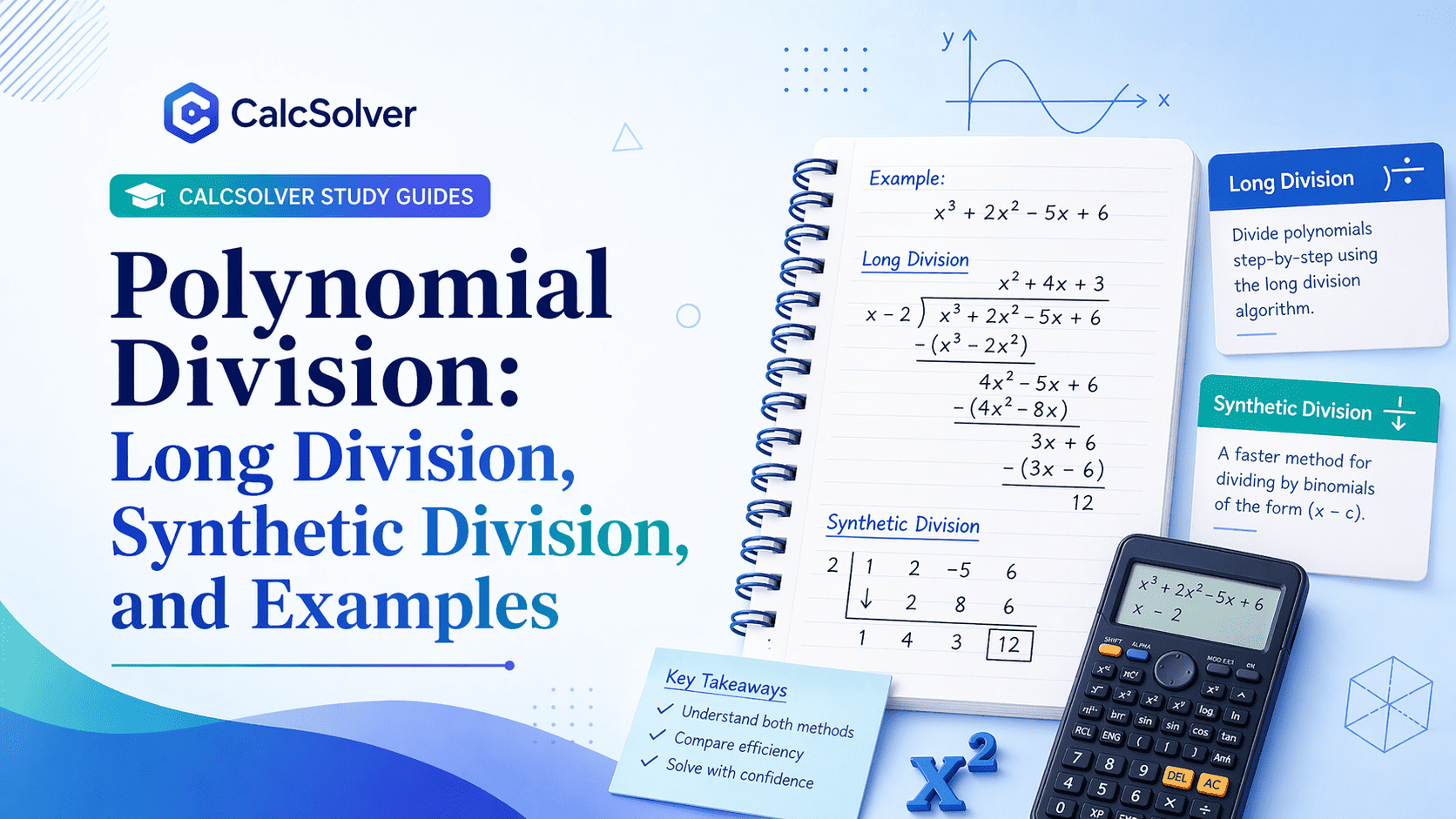
Polynomial Division: Long Division, Synthetic Division, and Examples
Polynomial division extends the same logic as ordinary number division: divide, multiply, subtract, and continue until the remainder is smaller than the divisor. Many students find the topic intimidating because the layout is longer, not because the underlying logic is different. Once the structure is clear, long division and synthetic division become very manageable.
The strongest mindset for this topic is to stop treating it as a brand-new chapter and start treating it as organized bookkeeping. Most errors happen because the work is misaligned, a sign flips unexpectedly, or a zero placeholder is missing. The concept is usually easier than the presentation.
Applicable Use Cases
Polynomial division is used when simplifying rational expressions, finding factors, applying the Remainder Theorem, and rewriting a polynomial in quotient-plus-remainder form. It also helps connect factoring and root-finding because dividing by (x - a) is closely tied to evaluating the polynomial at a.
It also gives students a way to check whether a suspected factor actually works. In that sense, polynomial division is not only a mechanical process. It is a structural test.
It is also one of the best chapters for training mathematical organization. Clean layout, correct term alignment, and patient subtraction matter here more than speed.
Method Ideas
Long division follows a fixed cycle: divide the leading term, multiply the divisor, subtract, and bring down the next term. Synthetic division is a shortcut when the divisor is linear and written in the form (x - a). In both methods, coefficient order matters. Missing powers must be represented with zero placeholders if necessary.
The reason synthetic division works is that it compresses the same arithmetic into a smaller table. It is faster, but only when the divisor has the right form. If the divisor is not linear, long division remains the safer general method.
A helpful way to choose between methods is simple: if the divisor is linear and the polynomial is already in descending powers, synthetic division is often worth using. If the divisor is more complicated or the setup is messy, long division is more transparent.
Worked Examples
Example 1: Divide x^3 + 2x^2 - 5x - 6 by x - 2. Long division gives the quotient x^2 + 4x + 3 with remainder 0.
Example 2: Divide x^3 + 1 by x - 1. Write the missing powers as x^3 + 0x^2 + 0x + 1. This keeps the coefficient positions correct.
Example 3: Use synthetic division on x^3 - 6x^2 + 11x - 6 with divisor x - 2. Using 2 on the left gives a remainder of 0 and quotient coefficients 1, -4, 3, so the quotient is x^2 - 4x + 3.
Example 4: Divide 2x^2 + 7x + 3 by x + 3. Use synthetic division with -3 because x + 3 = x - (-3).
Example 5: Interpret the result. If division by x - a leaves remainder 0, then x - a is a factor of the polynomial.
Example 6: Why placeholders matter. If a polynomial skips an x-term or constant term, the zero placeholder keeps the coefficient positions aligned. Without it, the entire synthetic-division table shifts and the answer becomes unreliable.
Example 7: Quotient-plus-remainder form. After division, the result can always be written as quotient plus remainder over divisor. That representation matters later when rational expressions are simplified or interpreted.
Common Mistakes
The most common mistake is sign handling during subtraction. Another is forgetting zero placeholders for missing terms. In synthetic division, students often use the wrong value on the left because they do not convert x + 3 into x - (-3).
Another issue is stopping too early or misreading the final row. The last number is the remainder. The earlier numbers are the coefficients of the quotient, not the full answer by themselves unless you rebuild the quotient correctly.
Students also confuse speed with correctness and reach for synthetic division when the divisor is not actually in the correct linear form. The shortcut only helps when the setup matches the method.
FAQ
When should I use synthetic division?
Use it when the divisor is linear and written as x - a.
What if a power is missing from the dividend?
Insert a zero coefficient placeholder so the term order stays aligned.
How do I check my answer?
Multiply the quotient by the divisor and then add the remainder. The result should match the original dividend.
Difference from Nearby Tools
Use Remainder Theorem when you only need the remainder for a linear divisor. Use Factoring Polynomials when division is being used to confirm a factor. Use the Scientific Calculator to test the dividend and quotient expression numerically at sample x values.
Study Advice
Keep the layout clean. Most division mistakes are bookkeeping mistakes, not concept mistakes. It also helps to say the cycle out loud while practicing: divide, multiply, subtract, bring down. Repetition turns a long-looking topic into a predictable procedure.
The broader lesson is that division is often the bridge between a polynomial and its deeper structure. If you can divide cleanly, you can test factors, connect to remainders, and understand the expression more flexibly.
A useful practice pattern is to do one problem in long division first and then repeat a matching linear-divisor problem with synthetic division. Seeing both methods side by side makes the shortcut feel earned instead of arbitrary.
Applied learning context
How this topic appears in real coursework
In real classes, this topic usually appears inside mixed assignments instead of in isolation. Students may need to combine definitions, formulas, and interpretation in a single response, which is why practicing only one template answer is often not enough. A stronger routine is to check what the question is really asking, identify the required variables, then map the setup to the correct method before calculating.
Common reasoning traps and how to prevent them
The most frequent mistakes happen before arithmetic starts: reading symbols too quickly, mixing units, applying the wrong formula, or skipping assumptions. To avoid this, write a short pre-check line for each problem: identify known values, unknown values, constraints, and expected answer size. This one-minute habit prevents many avoidable errors and improves final answer quality more than repeated button pressing.
How to self-verify before submitting answers
After solving, verify by estimation and by method. Estimation checks whether the result is in a plausible range. Method checks whether each step still matches the original question intent. If either check fails, revise the setup first instead of retyping numbers. This approach builds transferable problem-solving skill, not just short-term answer accuracy.